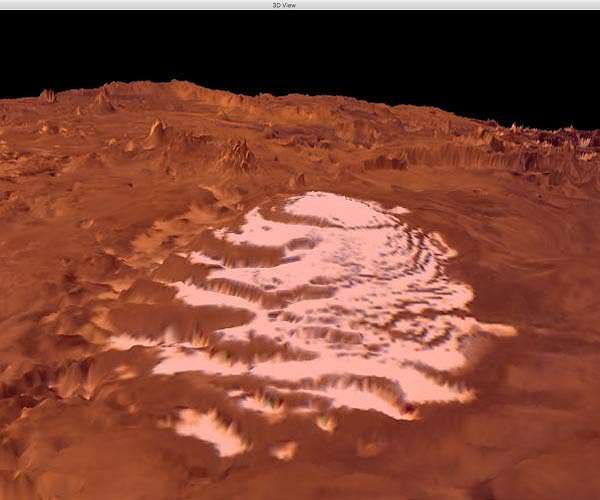
Glaciers of carbon dioxide are moving, creating deposits kilometers thick today across the south polar region of Mars, something that could have been going on more than 600,000 years, a paper by Planetary Science Institute Research Scientist Isaac Smith says.
"The CO2 deposits that were first identified in 2011 turn out to be flowing today, just like glaciers on Earth," said Smith, lead author of "Carbon Dioxide Ice Glaciers at the South Pole of Mars" that appears in the Journal for Geophysical Research – Planets.
"Approximately 600,000 years ago CO2 ice started forming at the Martian south pole. Due to climate cycles, the ice has increased in volume and mass several times, interrupted by periods of mass loss through sublimation," Smith said. "If the ice had never flowed, then it would mostly be where it was originally deposited, and the thickest ice would only be about 45 meters thick. Instead, because it flowed downhill into basins and spiral troughs – curvilinear basins – where it ponded, it was able to form deposits reaching one kilometer thick.
"The glaciers have enough mass that if sublimated, they would double the atmospheric pressure of the planet. It's a stunning quantity, and a 2018 paper by PSI Senior Scientist Than Putzig measured it most accurately," Smith said. "The longest glacier is about 200 kilometers long and about 40 kilometers across. These are big! That activity is ongoing, but flow rates probably peaked about 400,000 years ago when deposition was greatest. We're in a slow period because the ice is decreasing in mass, and that slows down glaciers."
Recent work conducted in part at PSI (and funded to Smith) investigated the flow laws, or strength properties of carbon dioxide ice. That work found that CO2 ice flows close to 100 times faster than H2O ice in Martian conditions and on high slopes. This is why the CO2 ice behaves as glaciers where the rest of the H2O ice cap that supports it appears stationary.
Analysis of glacial modeling results, using NASA's Ice Sheet and Sea-Level System Model, supported by two co-authors and adapted by Smith to work on Mars and with CO2, showed that the CO2 ice had not been moved by typical methods. "Atmospheric deposition would put the ice in a pattern we don't see. It would be much more evenly spread and thinner. What the glacier interpretation provides is a mechanism to move the ice from high places, into the lower basins that are also at lower latitude," Smith said.
"If atmospheric deposition were the only process acting on the ice, then most of it would be found at the highest latitude and highest elevation. That's just not the case. The ice is flowing downhill into basins, much like water flows downhill into lakes. Only glacial flow can explain the distribution we found in 2018."
Additional work by Smith and his team found several surface features that are very good analogues to features we see on terrestrial glaciers. Those include topographic profiles, crevasses, and compression ridges that resemble terrestrial features. This strengthened the conclusions and provided a basis to compare with the models.
Earth, Mars and Pluto are the only bodies in the Solar System known to have actively flowing ice, but they're probably not alone. Numerous types of ice exist in the solar system, and with the count of dwarf plants increasing, it's likely that some of them will have glaciers of carbon monoxide or methane, even more exotic than the dry ice glaciers just discovered on Mars.
Research Report:"Carbon Dioxide Ice Glaciers at the South Pole of Mars"
Research Report:Three-dimensional radar imaging of structures and craters in the Martian polar caps