
 |
 |
 |
 |
 |
 |
 |
 |
 |

 |
Boeing Australia To Provide Australia Its First Tactical UAV
Brisbane, Australia (SPX) Dec 15, 2006 Boeing Australia Limited has signed a contract to provide the Commonwealth of Australia its first Tactical Unmanned Aerial Vehicle (TUAV) capability under Joint Project (JP) 129. Boeing Australia, with partner Israel Aircraft Industries' (IAI) MALAT Division, will deliver the I-View 250A TUAV and associated systems to the Australian Army, providing new airborne surveillance, reconnaissance and target acquisition capabilities. Boeing Australia is the prime contractor and has responsibility for program management, systems engineering and technical management; and integrated logistics support. IAI will deliver the I-View 250A TUAV system. Boeing Australia Managing Director David Withers said the company is looking forward to introducing a new capability into the Australian Defence Force (ADF) that will put it at the forefront of global TUAV technology. "The I-View is the first of its type in Australia and one of the most advanced TUAVs in the world, and we are very proud to deliver both a new capability and a new platform to the Australian Defence Force," said Withers. "The solution that we have developed will leverage Boeing Australia's ability to manage large-scale defence projects and the experience and global success of IAI's UAV family," he continued. "The JP 129 TUAV capability will become an integral part of Australia's network-centric defence framework." Itzhak Nissan, president and chief executive officer of IAI, said, "IAI regards the ADF to be a most important and esteemed customer. We are proud that the ADF selected the I-View as its TUAV system. "IAI/MALAT is proud to provide the ADF with a fourth-generation TUAV system based on our more than 30 years of extensive experience with UAV technology. I-View offers not only high performance and flexibility, but also future growth to support the ADF's operational needs." The I-View 250A TUAV mission system will provide a new level of sophisticated reconnaissance and surveillance capability for the ADF. Its significant endurance and payload capabilities allow it to detect, identify and monitor targets at ranges up to 150 km from its launch site. Other notable features include catapult or conventional runway launch, fully automatic recovery via conventional or powered parafoil and data link equipment based on the U.S. Common Data Link standard to facilitate interoperability with allied forces. Remote video terminals delivered as part of the mission system will allow all mounted or dismounted Army units to receive the images directly. These deployed units, communicating through radio relay capabilities onboard the TUAVs, will be able to direct the sensors to new areas of interest in near real-time, providing a vital edge to soldiers engaged in an increasingly complex and rapidly evolving battlespace. IAI's MALAT Division is a world leader in developing and integrating UAV systems. IAI UAVs have accumulated, worldwide, more than 300,000 operational flight hours to date. IAI MALAT UAV systems are operated by 27 customers including the Israeli Defense Forces, U.S. Army, Navy and Marine Corps, Finnish Army, Swiss Army, French Air Force, Belgian Army and Indian Armed Forces. Community Email This Article Comment On This Article Related Links Boeing Integrated Defense Systems UAV Technology at SpaceWar.com UAV News - Suppliers and Technology
 Boeing, U.S. Air Force Demonstrate UAV Automated Aerial Refueling Capability
 St. Louis MO (SPX) Dec 14, 2006
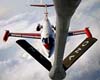
Under a U.S. Air Force Research Laboratory industry team, the Boeing Automated Aerial Refueling (AAR) program successfully completed flight tests in August that demonstrated for the first time an unmanned air vehicle's ability to autonomously maintain a steady refueling station behind a tanker aircraft. |
|
|

| The content herein, unless otherwise known to be public domain, are Copyright 1995-2006 - SpaceDaily.AFP and UPI Wire Stories are copyright Agence France-Presse and United Press International. ESA PortalReports are copyright European Space Agency. All NASA sourced material is public domain. Additionalcopyrights may apply in whole or part to other bona fide parties. Advertising does not imply endorsement,agreement or approval of any opinions, statements or information provided by SpaceDaily on any Web page published or hosted by SpaceDaily. Privacy Statement |

