
MARSDAILY
Back on the Job: Sol 3715
by Scott VanBommel | Planetary Scientist - Washington University
Pasadena CA (JPL) Jan 18, 2023

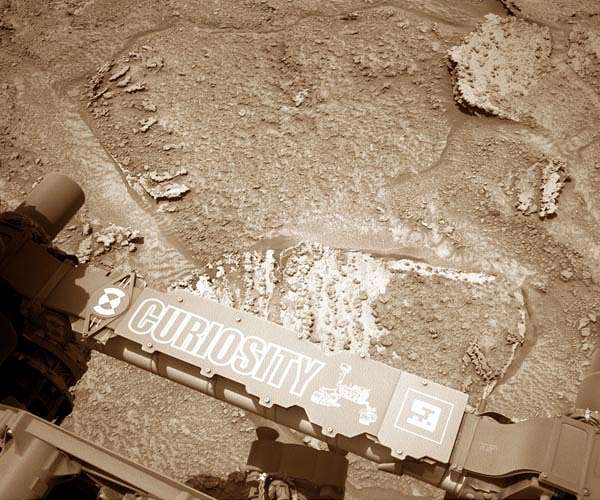
This image was taken by Left Navigation Camera onboard NASA's Mars rover Curiosity on Sol 3714. Credits: NASA/JPL-Caltech.

Curiosity's science and engineering team members were back at it today after a holiday long weekend, while Curiosity itself was ready and waiting after its own soliday weekend. With the data from the holiday-soliday plan in hand, Curiosity's team was faced with the decision whether or not to drill our current location, and, if so, where.

The Marker Band has proven elusive to drill. Curiosity has tried twice prior (e.g., sol 3676 and sol 3682-3683 blogs) and today's workspace, in particular the bright material right above Curiosity's iconic arm in the included image, was hopefully going to prove fruitful on this our third attempt.

However, once again, Mars had different ideas as drilling was deemed not possible here due to the nodular and bumpy nature of the workspace. We will instead execute a short drive, or bump, 3 m from our current location to a new location named "Guramoni," where the conditions for drilling look more favourable.

Complementing the drive in today's one-sol plan is a brush of the target "Tarra" followed by a quick touch-and-go APXS analysis as well as MAHLI and Mastcam images.

Further imaging and a ChemCam 5x1 LIBS raster on "Faro" round out the activities at our current location ahead of bumping to Guramoni. Finally, Curiosity wraps tosol's planned activities by acquiring the requisite post-drive images, which shall arrive via a MAVEN relay in time for tomorrow's team to assess the new workspace for drilling suitability.


Related Links
Curiosity Mars Science Laboratory
Mars News and Information at MarsDaily.com
Lunar Dreams and more

MARSDAILY
To the Marker Band again: Sols 3712-3714
Pasadena CA (JPL) Jan 18, 2023
We received the data that we had been missing during Wednesday's planning, so we hit the ground running today, ready to plan for contact science and our drive onto the Marker Band in this new location! Early in planning the Geology and Mineralogy science theme group selected two targets in our workspace that will be brushed and examined with MAHLI and APXS named "Paredao" and "Curupira." ChemCam will also be able to observe targets in the workspace, hitting one of the contact science targets, Pare ... read more

Comment using your Disqus, Facebook, Google or Twitter login.

Share this article via these popular social media networks
del.icio.usdel.icio.us DiggDigg RedditReddit GoogleGoogle

MARSDAILY
Light-based tech could inspire Moon navigation and next-gen farming

Researches on Chang'e 5 lunar samples gain fruitful results

New photos from China's lunar rover released with New Year blessings

Buzz Aldrin, second man on the Moon, marries on 93rd birthday

MARSDAILY
China to launch 200-plus spacecraft in 2023

Chinese astronauts send Spring Festival greetings from space station

China's space industry hits new heights

China's first private sector 2023 rocket launch up, up and away

MARSDAILY
Asteroid findings from specks of space dust could save the planet

NASA's Lucy Mission Suspending Further Solar Array Deployment Activities

Hera's time of trial

Psyche continues preparation for October launch

MARSDAILY
Exotic water ice contributes to understanding of magnetic anomalies on Neptune and Uranus

Tumultuous migration on the edge of the Hot Neptune Desert

From Europe to Jupiter via Kourou

Airbus finalises JUICE ready for its mission to Jupiter

MARSDAILY
Webb Space Telescope, Keck team up to study Saturn's moon Titan

MARSDAILY
New study shows 'self-cleaning' of marine atmosphere

Future-proofing ice measurements from space

Geotail operations come to an end after 30 years

Utah researcher to lead study of clouds in cleanest air on Earth

MARSDAILY
Astronauts conduct first ISS spacewalk of 2023

RIT scientists help rediscover earliest known star map using multispectral imaging

Zero-Covid left in dust as Chinese revellers fuel travel boom

Crop seeds, microbial strains tested in China's two space missions unveiled

MARSDAILY
New small laser device can help detect signs of life on other planets

Webb Telescope identifies origins of icy building blocks of life

Rare opportunity to study short-lived volcanic island reveals sulfur-metabolizing microbes

How do rocky planets really form