
Mars Exploration News
MARSDAILY
Ancient Martian brines left bromine rich fingerprints in jarosite minerals
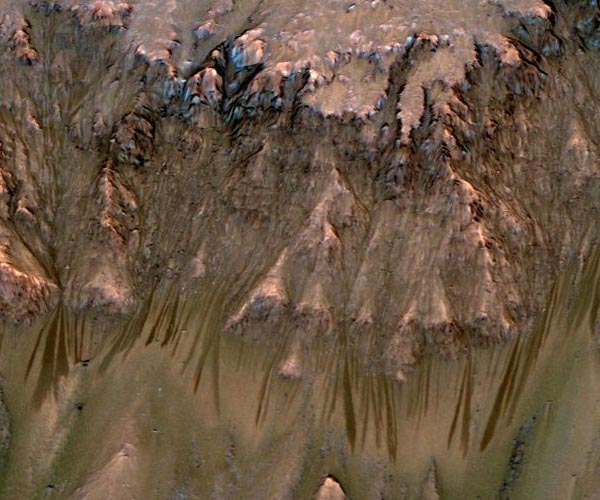
illustration only

Ancient Martian brines left bromine rich fingerprints in jarosite minerals

by Riko Seibo
Tokyo, Japan (SPX) Dec 14, 2025

Jarosite, a sulfate mineral widely detected on Mars, records interaction between acidic, oxidizing waters and the planet's surface rocks, but the halogen chemistry of those fluids has been difficult to reconstruct. New experimental work examines how bromine and chlorine enter jarosite under Mars-like conditions, using them as tracers of fluid evolution and environmental conditions.

Researchers from the Institute of Geology and Geophysics, Chinese Academy of Sciences, and Chengdu University of Technology synthesized potassium-and sodium-jarosite to study how halogens partition into the mineral structure. Their study, published in the journal Planet, provides experimental evidence that jarosite preferentially captures bromine, especially under cold near-surface conditions proposed for early Mars.

To simulate plausible Martian environments, the team produced jarosite via two routes: low-temperature Fe2+ oxidation at 25 C and hydrothermal Fe3+ hydrolysis at 140 C. They then combined X-ray diffraction, Raman spectroscopy, and X-ray fluorescence to quantify halogen uptake and determine where bromine and chlorine substitute within the jarosite crystal lattice.

The experiments show a consistent trend in which bromide is favored over chloride during incorporation into jarosite. In potassium jarosite formed at 25 C, solid-liquid partition ratios for bromide reached values up to 18, while sodium jarosite remained halogen-poor under all tested conditions. The identity of the alkali cation at the A-site controls this behavior, with K-bearing jarosite accommodating far more halogen substitution than its Na analog.

Multiple lines of evidence, including contraction of lattice parameters, changes in Raman O-H stretching bands, and stoichiometric balances, indicate that bromine and chlorine mainly replace structural hydroxyl groups rather than occupying interlayer sites. This substitution leads to measurable lattice contraction, most pronounced in bromine-enriched potassium jarosite formed at low temperature. Formation temperature exerts a major control, with low temperatures enhancing bromine uptake through slower crystallization and defect-mediated trapping, while higher-temperature hydrothermal conditions yield more crystalline but halogen-poor jarosite.

These findings align with previous work on bromine-enriched evaporitic double salts produced under Martian-relevant conditions, indicating that jarosite functions as a selective bromine sink in cold, acidic brines similar to those inferred for early Mars. The study therefore links jarosite composition, formation temperature, and halogen capture in a single geochemical framework.

For planetary science, bromine-rich jarosite, especially potassium-dominated varieties, emerges as a potential indicator of low-temperature, chemically evolved brines and more persistent aqueous activity on ancient Mars. Jarosite thus serves both as a record of past environments and as an active phase in halogen cycling on planetary surfaces.

These results are expected to guide future Mars Sample Return analyses, where detailed study of sulfate minerals could clarify the chemistry, timing, and evolution of Martian waters. Laboratory synthesis tied to orbital and in situ observations strengthens efforts to reconstruct the history of water, habitability, and chemical evolution on the Red Planet.

Research Report:Halogen partitioning and structural incorporation in K-and Na-jarosite: Experimental insights under Mars-relevant conditions

Related Links
Higher Education Press Planet journal
Mars News and Information at MarsDaily.com
Lunar Dreams and more

Subscribe Free To Our Daily Newsletters
Tweet

RELATED CONTENT
The following news reports may link to other Space Media Network websites.
MARSDAILY
Martian butterfly crater reveals low angle impact and buried lava history
Paris, France (SPX) Dec 08, 2025
ESA's Mars Express orbiter has observed an impact crater in Mars's northern lowlands whose shape resembles a butterfly, created when an incoming space rock struck the surface at a shallow angle. The main crater, which appears somewhat like a walnut from orbit, measures about 20 km east to west and 15 km north to south and sits within the Idaeus Fossae region. The impact threw material preferentially to the north and south, forming two lobes of ejecta that extend as raised, wing-like terrain. Under ... read more

MARSDAILY
NASA prepares new lunar dust and seismic studies for Artemis IV

Lunar dust study links space weathering to changes in Moon ultraviolet brightness

Congress warned that the U.S. faces a new space race with China

Astrobotic lunar surface sensor to track cislunar traffic and security

MARSDAILY
Experts at Hainan symposium call for stronger global space partnership

Foreign satellites ride Kinetica 1 on new CAS Space mission

Triple Long March launches mark record day for Chinese space program

China prepares Qingzhou cargo ship for low cost resupply flights

MARSDAILY
ICE-CSIC leads a pioneering study on the feasibility of asteroid mining

OSIRIS-APEX spacecraft completes Earth flyby on its journey to explore Apophis

40 000 near-Earth asteroids discovered!

Lunar impactor Theia originated near Earth and Sun analysis reveals

MARSDAILY
Uranus and Neptune may be rock rich worlds

SwRI links Uranus radiation belt mystery to solar storm driven waves

Looking inside icy moons

Saturn moon mission planning shifts to flower constellation theory

MARSDAILY
Cassini study reveals organic compounds from Enceladus ocean plume

Saturn's icy moon may host a stable ocean fit for life, study finds

Unexpected discovery on Saturn's moon challenges our view on chemistry before life emerged

Cassini proves complex chemistry in Enceladus ocean

MARSDAILY
Outage Prevention from Orbit: Why Utilities Are Turning to Satellites and Geospatial Analytics

Gilat wins 10 million dollar order for transportable direct downlink earth observation system

IHI SAT2 hyperspectral CubeSat enters orbit to support forest monitoring and carbon data

LizzieSat 3 completes bus commissioning for multi mission AI operations

MARSDAILY
Lodestar Space wins SECP support to advance AI satellite awareness system

ISS to change commanders before Soyuz crew leaves orbit

Micro nano robots aim to cut carbon buildup in closed life support systems

NASA extends ISS National Lab management contract through 2030

MARSDAILY
Subaru OASIS survey uncovers massive planet and brown dwarf

The bacteria that wont wake up found in spacecraft cleanrooms

Supernova mixing traced as source of key life elements

RISTRETTO spectrograph cleared for Proxima b atmospheric hunt

Subscribe Free To Our Daily Newsletters


The content herein, unless otherwise known to be public domain, are Copyright 1995-2024 - Space Media Network. All websites are published in Australia and are solely subject to Australian law and governed by Fair Use principals for news reporting and research purposes. AFP, UPI and IANS news wire stories are copyright Agence France-Presse, United Press International and Indo-Asia News Service. ESA news reports are copyright European Space Agency. All NASA sourced material is public domain. Additional copyrights may apply in whole or part to other bona fide parties. All articles labeled "by Staff Writers" include reports supplied to Space Media Network by industry news wires, PR agencies, corporate press officers and the like. Such articles are individually curated and edited by Space Media Network staff on the basis of the report's information value to our industry and professional readership. Advertising does not imply endorsement, agreement or approval of any opinions, statements or information provided by Space Media Network on any Web page published or hosted by Space Media Network. General Data Protection Regulation (GDPR) Statement Our advertisers use various cookies and the like to deliver the best ad banner available at one time. All network advertising suppliers have GDPR policies (Legitimate Interest) that conform with EU regulations for data collection. By using our websites you consent to cookie based advertising. If you do not agree with this then you must stop using the websites from May 25, 2018. Privacy Statement. Additional information can be found here at About Us.