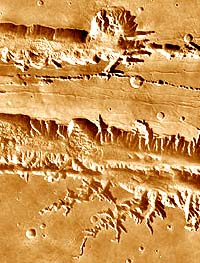
Although a landing spot in the Marineris Valley was considered somewhat inferior to the possible crater lake sites, sending the first 2003 rover -to Marineris Valley still remains a very serious possibility.
Although a landing spot in the Marineris Valley was considered somewhat inferior to the possible crater lake sites, sending the first 2003 rover -to Marineris Valley still remains a very serious possibility. |
Moreover, the canyons' great walls will be plainly visible from these landing sites, which would allow the rovers to examine the appearance and composition of all the sedimentary and/or volcanic layering up and down the walls with their cameras and their own onboardThermal IR spectrometers, as well as providing downright spectacular views for the general public. (Whatever one says about the virtues of the Hematite Plain, its flat terrain is likely to look pretty dull.)
Although a landing spot in the Marineris Valley was considered somewhat inferior to the possible crater lake sites, sending the first 2003 rover to Marineris Valley still remains a very serious possibility.
Two spots in particular are on its top-priority list. One is in Eos Canyon in the eastern end of the Marineris Valley, which apparently served both as an outflow channel through which floods poured out of the Valley complex onto the plains beyond, and at other times as an area in which water pooled to form a deep lake.
Its main attraction is the fact that its floor may contain a wide variety of different types and ages of rocks swept out of the valley; but by the same token, they're likely to be so intermixed that there might be trouble properly interpreting the rover's geological analyses of them.
The other site -- back toward the middle of the Valley complex -- is Melas Canyon, whose floor is largely covered with hundreds of shallowly-sloping sedimentary layers of some kind, like those around the periphery of Gale crater.
Once again, a rover here would have a good chance of determining whether these layers were made out of water-deposited sediment, or made out of windblown dust or volcanic ash that was gradually cemented into rock by processes that may have required only small traces of liquid water.
MER-A's remaining top-priority landing site candidate is, again, located on the Isidis rim but rendered somewhat unlikely by Beagle 2's nearby landing -- while its remaining second-priority candidates include five more in parts of the Marineris Valley (including a second landing ellipse in Eos Canyon), one at the mouth of the Duirius Valley outflow channel, and one more site each on the rims of the Isidis and Elysium Plains and in the southern cratered highlands.
There must be a separation of at least 37 degrees over Mars' curved surface between Rovers A and B, so that ground stations can communicate with them only one at a time -- but this places very few restrictions on possible landing site choices for the two rovers.
What's next?
The next phase of the selection process involves considerable additional high-quality, 2-meter resolution photography of samples of the 32 remaining candidates by MGS' "MOC" camera to see whether the local terrain really is smooth enough to be acceptably safe -- with 12 of the sites getting intensive attention, and the others as long-shot backups. This process began in February.
In September, a meeting will reexamine the prioritization list of the landing site candidates, to see whether some look more attractive than before and others less so, and MGS' remaining photography schedule will be adjusted accordingly.
Then, in April 2002, a second all-out Landing Site Workshop will focus on the top two remaining site candidates for each rover, with the final decision being made two months later -- a year before launch.
One development, however, might upset the applecart; and that is the possibility the 2003 MER rover project -- which has encountered some delays and cost overruns due to technical problems -- might have to flat-out cancel one of the rovers later this year.
The increase in Mars program funding proposed by the Bush Administration, even if it's shrunk somewhat by Congress, will probably prevent that. But if it does happen, the planetary geologists will have to decide whether to aim the remaining rover at the Meridiani hematite formation, or -- as a longer shot -- to aim it at one of the rougher and more adventurous targets. Stay tuned.
