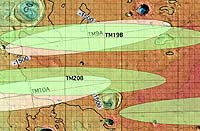
Potential landing ellipses in the Terra Meridiani region where substantial Hematite deposits have been identified
Potential landing ellipses in the Terra Meridiani region where substantial Hematite deposits have been identified |
In order to get both enough daily sunlight and high enough temperatures to operate successfully for the minimum three months demanded of them, the rovers must land fairly close to the Martian equator -- "MER-A" (the first rover) between 5 deg North and 15 deg South; MER-B between 10 degrees North and 10 degrees South.
For their braking parachutes to slow them down enough for a successful landing, they must land at sites more than 1.3 km below the average altitude of the Martian surface.
Despite their ruggedness, it's dangerous for them to land on slopes of over 15 degrees -- that is, on steep hills, cliffs or crater walls -- or in excessively rock-strewn areas which could also be hard for the rovers to weave their way through after landing.
Overly dusty areas would be safe to land on, but would also interfere with the rovers' travels because of traction and dust problems.
Then there is the problem of their "landing ellipses" -- the very wide areas in which we can be confident they will touch down, given the built-in inaccuracies of their Earth-based navigational tracking.
The cancelled 2001 lander would have featured an experimental new guidance system that would have guided it to within 10 km of its target point, but that test has now been postponed until 2007.
The Vikings, Pathfinder and the Mars Polar Lander all landed within 30 km of their target points, but that may have been pure luck -- the 2003 rovers can only be sure of landing within a zone stretching 30 km north-to-south, and between 60 to 220 km east-to-west depending on the site's latitude. Therefore any landing site must be picked on the basis that a safe landing is essentially possible anywhere within that big landing ellipse.
Despite all these limitations the first survey of Mars' surface for possible landing sites for 2003 found a surprising number of "safe" candidates -- 85 for MER-A and 68 for MER-B. These sites were chosen on the basis of:
But this search was complicated by the fact that any area selected must have scientifically interesting features within virtually every part of its big landing ellipse, since there is no way to be certain just where within an ellipse the lander will come down, and the rover will most likely have a range of only a kilometer or so beyond that point.
At the start of the January Landing Site Workshop, the planetary geologists taking part had provided a total of 39 especially scientifically promising choices among the usable landing site ellipses. These fell into five general categories:
