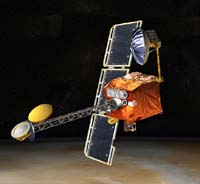
Odyssey in orbit
Odyssey in orbit |
"As with any new camera, it takes a while to get all the settings right to optimize the picture quality," said Dr. Philip Christensen, principal investigator for the thermal emission imaging system at Arizona State University, Tempe. "Once we get the system calibrated, there will be a tremendous flow of image data."
The gamma ray spectrometer instruments are collecting data on the composition of the martian surface. The door on the gamma ray sensor was opened yesterday, allowing the instrument to cool down to its operating temperature. The instrument will be fully operational later this week. The neutron spectrometer and high-energy neutron detector are collecting data that scientists expect will show the location of hydrogen on Mars, which may indicate deposits of water ice.
Having passed these milestones, engineers plan to begin troubleshooting the martian radiation environment experiment next week. The process of evaluating the status of the instrument could continue for several weeks. The radiation experiment stopped communicating and was turned off in August 2001.
Related Links
 Odyssey Deploys Main Link To Earth
 Pasadena (JPL) Feb 6, 2002