The US Spirit robot will make its first three-meter trek on Mars late Wednesday, as part of its mission to seek out traces of water on the Red Planet, to determine if life once existed there, NASA officials said Wednesday.
"We will be driving three meters (10 feet) on the surface of Mars," said NASA's Kevin Burke, who is overseeing the robot's descent from its platform, where it has sat since arriving on the planet January 3.
The first data from Spirit are expected at NASA's Jet Propulsion Laboratory in Pasadena, California, at around 0900 GMT Thursday, mission manager Jennifer Trosper told reporters.
Then on Friday, the robot's 13th day on Mars, the European probe Mars Express will pass over the planet's Gusev crater, where Spirit landed, said Ray Arvidson, one of the Mars Exploration Rover's project scientists.
Mars Express may not be able to "see" Spirit, but the probe will take a series of measurements that will prove helpful to the US mission, via three German, French and Italian instruments "looking down," Arvidson said, praising the cooperative effort.
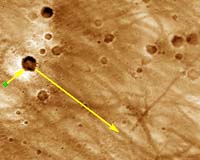
"To our northeast, 250 meters (820 feet) to the northeast, is a crater 200 meters (655 feet) in diameter. This is an extremely attractive target," said mission scientist Steve Squyres, noting that it will "provide a window into the subsurface of Mars."
"The goal of this site is to try to find materials that will tell us whether or not Gusev crater once contained a lake and what the conditions were like in that lake," Squyres said.
A second robot, Opportunity, is set to land on Mars late January 24. Each robot will operate for three months on the planet, running on solar energy.
All rights reserved. � 2004 Agence France-Presse. Sections of the information displayed on this page (dispatches, photographs, logos) are protected by intellectual property rights owned by Agence France-Presse. As a consequence, you may not copy, reproduce, modify, transmit, publish, display or in any way commercially exploit any of the content of this section without the prior written consent of Agence France-Presse.