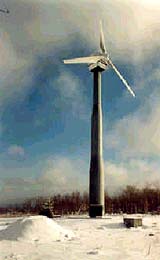
Wind turbines designed to make electricity at the South Pole and in remote regions of Alaska may someday lead to similar wind machines for Mars bases, according to NASA scientists.
During missions to Antarctica, where there are about six months of darkness each year, NASA scientists first seriously considered modifying cold-weather wind machines so they could make vital electric power for bases on Mars.
One reason scientists proposed use of wind power on Mars is that wind turbines still could generate electricity during month-long martian global dust storms that can make days on the red planet as dark as night.
"Wind power and solar power may complement each other on Mars. When you have a large dust storm blocking the sunlight on Mars, a wind turbine can still generate electricity," said scientist David Bubenheim of NASA's Ames Research Center in California's Silicon Valley.
"Only during dust storms on Mars is there enough wind energy to operate a wind turbine," said Michael Flynn, another NASA Ames scientist. On Earth about 10 meters (33 feet) per second wind speed is needed to make electricity with wind turbines; on Mars about 30 meters (98 feet) is needed because of the extremely thin air, according to Bubenheim.
"What we are proposing is a hybrid wind-solar system," Flynn said. "This system would use solar cells to generate electricity during sunny periods, and a wind turbine to make electricity during dust storms."
"We've looked at wind profiles based on atmospheric computer models of Mars," Bubenheim said. A scheme of complementary wind and solar power appears to be an option, he added.
Hard data from Viking and Pathfinder missions to Mars do not indicate strong martian winds, according to Flynn. "But those missions did not collect data during dust storms on Mars. Global computer models and wind tunnel tests indicate very high winds are required to start and maintain a dust storm on the red planet," he said.
"Our goal is to demonstrate that the solar-wind hybrid system can compete with traditional energy production systems in rural environments above the Arctic Circle," Flynn said. "By demonstrating the feasibility of a system on Earth, we are beginning to address the feasibility for a system on Mars."
"We have been working with a private contractor, Northern Power Systems, of Waitsfield, Vt., to develop these types of hybrid wind-solar systems, one of which is called the village power system," he said. "This system is under development for use in rural Alaskan villages."
Wind turbines that are able to operate in extremely cold, windy areas are scheduled for testing in Kotzebue, Alaska, location of a wind power test farm. The wind turbine system to be used in the Alaskan village power system won R&D Magazine's "R&D 100 Editors' Award" in 2000.
"Originally, we were using the Amundsen-Scott South Pole Station, where there are about six months of darkness, as a Mars analog," Bubenheim said.
"We were working with life support technologies, including growing fresh fruits and vegetables and recycling waste. Then we thought about using wind machines on Mars, too. People at both the South Pole Station and a space habitat have to be careful to efficiently use electricity," he explained.
Antarctica is sufficiently remote that getting diesel oil in is difficult, according to Bubenheim. The key issue at the South Pole, Mars and Alaska is maintainability in extreme environments. Wind machines must be able to operate in conditions of low temperature, frost and the presence of abrasive materials, such as sand, he said.