 |
 |
 |
 |
 |
 |
 |
 |
 |

 |
UCSB Researcher To Design Instrument To Test Soil On Mars
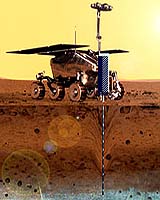
Santa Barbara CA (SPX) Dec 14, 2005 The European Space Agency announced Monday support of a new program that will include development of an instrument for testing deep soil samples on Mars in a European mission called ExoMars. A researcher at the University of California, Santa Barbara will direct the development of the instrument. "We are very excited about this," said Luann Becker, research scientist with the Institute of Crustal Studies at UC Santa Barbara. "It's a once-in-a-lifetime opportunity." Testing by the two NASA rovers that are currently operating on Mars has spurred interest in developing different, new, and highly-sensitive instruments to search for present or past life on Mars. The ExoMars rover will contain a drill that can reach soil samples up to two meters under the Martian surface in search of extinct or extant life. Becker, trained as an oceanographer and geochemist, is deeply involved in the study of the origin, evolution and distribution of life in the universe, a field known as exobiology. She is known for her development of a theory about a mass extinction (much earlier than that of the dinosaurs) and her team's finding of evidence of the impact of a meteor 250 million years ago in an area off the coast of present-day Australia. The impact apparently ushered in a period called the "Great Dying," the largest extinction event in the history of life on Earth, when 90 percent of marine life and 80 percent of life on land became extinct. She anticipates that the American contribution to the Molecular Organic Molecule Analyzer (MOMA) development by the European Space Agency (ESA) will be funded by NASA. MOMA will be included as part of the ExoMars mission to Mars in 2011. The discovery in 1996 of organic molecules enclosed in a meteorite �� that may be of Martian origin �� revived interest in the study of Martian soil. One entire category of meteorites on Earth has been identified to be of possible Martian origin because gases trapped in them match the composition of the Martian atmosphere. The opportunity to work with the Europeans makes the project especially appealing to Becker. "The Europeans are coming together to support this mission," said Becker. "U.S. support is also required. It's a very, very unique opportunity. We all have a unified goal." Her team includes many European scientists as well as two co-principal investigators from Johns Hopkins University. The Americans are: William B. Brinckerhoff from the Applied Physics Laboratory, and Robert J. Cotter of the Johns Hopkins School of Medicine's Department of Pharmacology and Molecular Sciences. The instrument will be developed in the Applied Physics and School of Medicine laboratories in affiliation with Johns Hopkins University. The decision about the mission came last week when ministers from the 17 ESA member states gathered in Berlin for an ESA council meeting. There they decided to pursue the overall core program of "Aurora," with its first Martian robotic exploration mission, ExoMars. Scheduled to be launched from Kourou, French Guiana, the ExoMars mission will deploy a highly mobile rover with a suite of exobiology instruments. The ExoMars mission was conceived as part of the Aurora preparatory program activities that were started in 2002 with the support of twelve participating nations: Austria, Belgium, France, Germany, Italy, the Netherlands, Portugal, Spain, Sweden, Switzerland, the United Kingdom, and Canada. In Berlin, 14 countries agreed to subscribe to the ExoMars mission. The 12 countries from the preparatory phase were joined by Denmark and Norway. Further contributions are still expected in the coming months. As far as the financial shares in the program are concerned, Italy has confirmed its leading role, followed by the United Kingdom, France, and Germany. These proportions will also be reflected in the selection of the industrial consortium that ESA will task to build the first European rover for the exploration of Mars, along with a carrier and a descent module. Decisions about the ExoMars spacecraft will be finalized in the next few months, with the aim of maximizing the mission's scientific return. Subject to the availability of national funding for their research, scientists from all states participating in the Aurora program are represented in the initial selection of instruments. The U.S. is included through the MOMA and one other organic detection instrument. The lead American scientist on the other organic detection instrument is Jeffrey L.Bada, professor at the Scripps Institute of Oceanography, University of California, San Diego. Together with the ExoMars mission, the other element of the Aurora Program, the so-called "Core Activities," were also approved in Berlin. The approval will allow for preparation for further exploration missions beyond ExoMars, such as the Mars Sample Return Mission in which samples will be brought back from Mars. ESA will continue the development of exploration-related technologies and capabilities, and develop a roadmap to raise awareness of the European involvement in space science activities. Community Email This Article Comment On This Article Related Links Institute of Crustal Studies University of California - Santa Barbara SpaceDaily Search SpaceDaily Subscribe To SpaceDaily Express Mars News and Information at MarsDaily.com Lunar Dreams and more
 Spirit Heading To 'Home Plate'
 Pasadena CA (JPL) Jan 09, 2006
Last week Spirit completed robotic-arm work on "El Dorado." The rover used all three of its spectrometers plus the microscopic imager for readings over the New Year's weekend. |
|
|

| The content herein, unless otherwise known to be public domain, are Copyright 1995-2006 - SpaceDaily.AFP and UPI Wire Stories are copyright Agence France-Presse and United Press International. ESA PortalReports are copyright European Space Agency. All NASA sourced material is public domain. Additionalcopyrights may apply in whole or part to other bona fide parties. Advertising does not imply endorsement,agreement or approval of any opinions, statements or information provided by SpaceDaily on any Web page published or hosted by SpaceDaily. Privacy Statement |