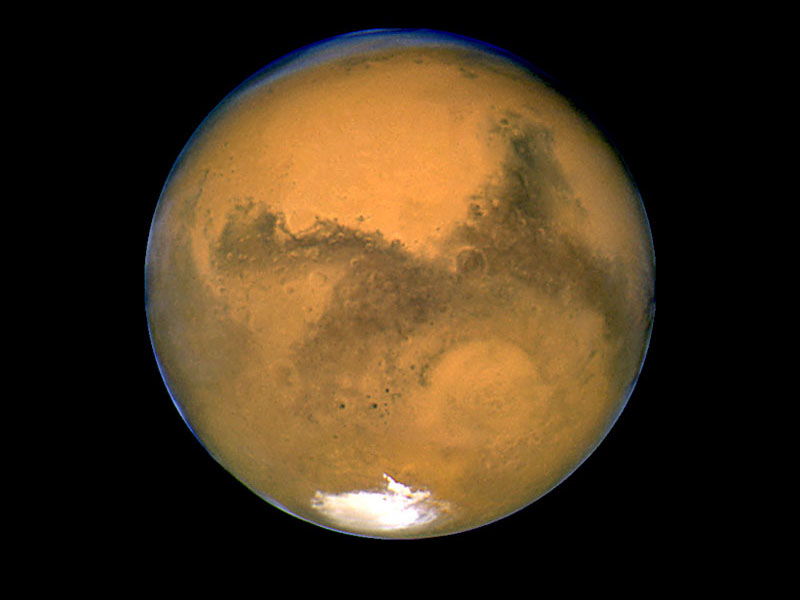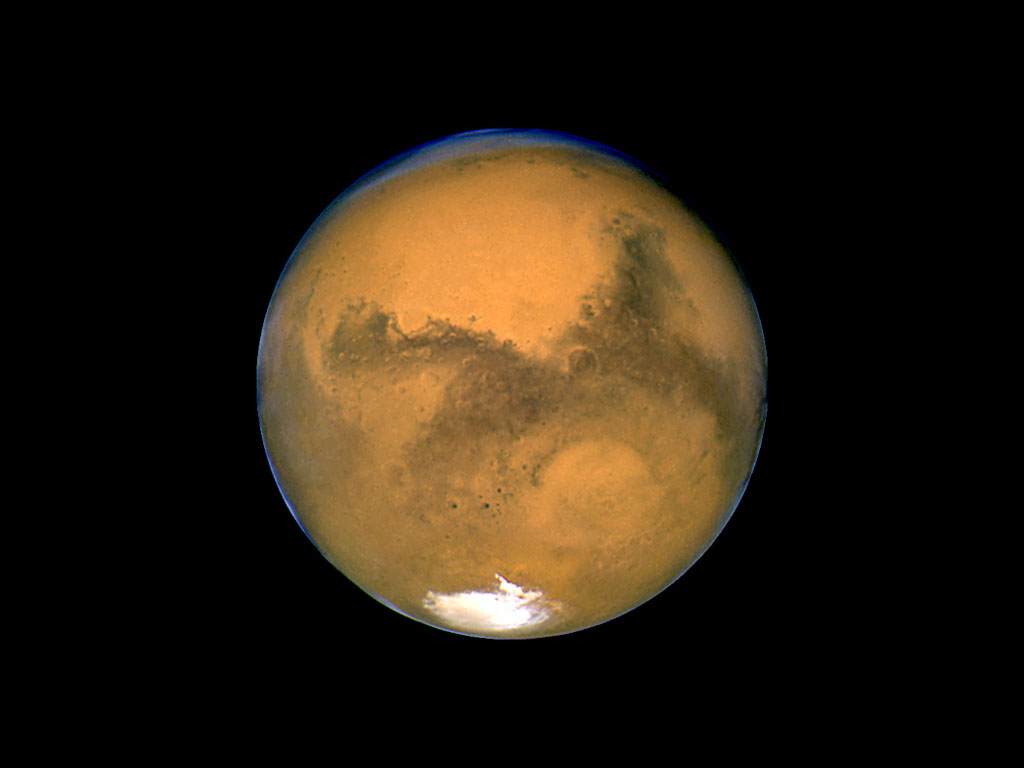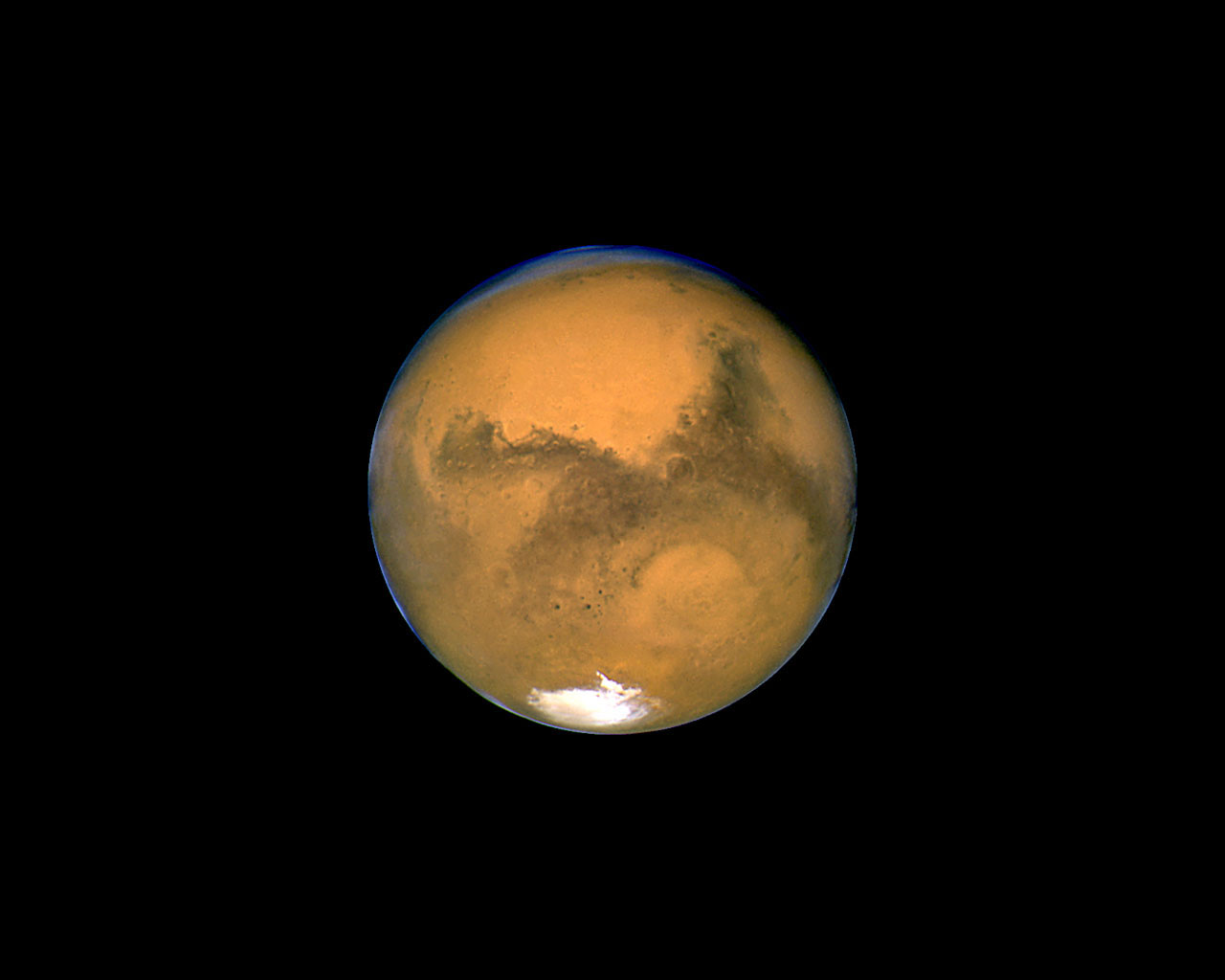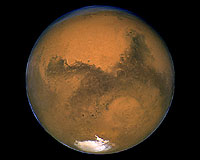
Mars 2003 by Hubble
Mars 2003 by Hubble |
Like millions of other people, she saw Mars for the first time on August 27th when the red planet made its closest approach to Earth in 60,000 years. It was dazzling, but ... "isn't Mars supposed to be gone now?"
No, Mom. In fact, Mars is even easier to see now than it was two weeks ago.
Consider this: Mars is receding from Earth at about 6,000 mph (2. 8 km/s). Maybe that sounds fast, but on the vast scale of the solar system it is not. Mars was 34,647,397 miles from Earth on August 27th. Today it is 35,532,907 miles away--not much different.
That's why Mars remains dazzling. It's still nearby. In fact, during the whole month of September Mars will be as close to Earth as it's going to get for the next 15 years.
Best of all, Mars getting easier to see. Why? Because it's up before bedtime. Like all stars and planets Mars rises about 4 minutes earlier each night. (This is a result of Earth's orbital motion around the sun.) Back on August 27th, Mars was barely above the horizon at sunset; you had to wait a while for it to rise. Now, though, Mars is higher in the sky when the sun goes down. People are noticing the red planet without even trying.
Eventually, of course, Mars is going to fade. By late September it will be only half as bright as it is now, and by mid-October only 20%. The fading quickens because Mars is receding a little faster each day. Only 6,000 mph now, the pace will increase nearly 3-fold to 16,500 mph (7.4 km/s) by the end of this month.
All these factors add up to one thing: September is a good time to observe Mars.
Even a modest backyard telescope, a 6- to 8-inch instrument, say, will reveal broad details on the planet's surface such as dark volcanic terrains and the bright south polar cap. Larger 12- to 16-inch telescopes equipped with CCD cameras can record spectacular images of individual volcanoes, wispy clouds and frosty mountains emerging near the south pole.
Or if you're like my mom, not ready to deal with telescopes, just use your naked eye. The planet that won't go away is a lovely sight no matter how you look at it.
Community
 Spirit Heading To 'Home Plate'
 Pasadena CA (JPL) Jan 09, 2006
| The content herein, unless otherwise known to be public domain, are Copyright 1995-2006 - SpaceDaily.AFP and UPI Wire Stories are copyright Agence France-Presse and United Press International. ESA PortalReports are copyright European Space Agency. All NASA sourced material is public domain. Additionalcopyrights may apply in whole or part to other bona fide parties. Advertising does not imply endorsement,agreement or approval of any opinions, statements or information provided by SpaceDaily on any Web page published or hosted by SpaceDaily. Privacy Statement |