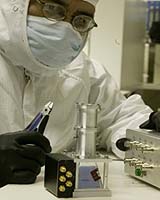
An instrument that will characterize the radiation at the surface of Mars has been selected by NASA for the Mars Science Laboratory (MSL). The mission, part of NASA's Mars Exploration Program, will explore the viability of the surface of the red planet as a potential habitat for past or present life.
For this purpose, Southwest Research Institute (SwRI) is developing the Radiation Assessment Detector, or RAD, to characterize the broad spectrum of radiation at the surface. The investigation will determine the radiation hazards faced by astronauts on Mars.
"Understanding the space radiation environment is the single most important challenge to preparing for future human exploration of Mars," says Dr. Donald M. Hassler, RAD principal investigator and section manager in the SwRI Space Studies Department.
"We need to understand the radiation input at the Martian surface so we can design shelters, habitats and spacesuits with sufficient shielding to protect astronauts."
"With this instrument we will perform the first-ever measurements of cosmic rays on the surface of another planet," says Dr. Arik Posner, RAD project scientist and researcher in the SwRI Space Science and Engineering Division.
"The data will help us to better understand the unique Martian radiation environment and its influence on past and present life, and is thus essential for the Space Exploration Initiative."
The Exploration Systems Mission Directorate at NASA Headquarters is funding the RAD development.
Seven other instruments were also selected for the MSL, including a mast camera, a Mars hand lens imager and a Mars descent imager, all led by Malin Space Science Systems; a chemistry and micro-imaging sensor, led by Los Alamos; an alpha-particle-X-ray-spectrometer, led by the Max-Planck-Institute for Chemistry; an X-ray diffraction and fluorescence instrument, led by the NASA Ames Research Center; and a sample analysis instrument, led by the NASA Goddard Space Flight Center.
MSL will also carry a pulsed neutron source and detector for measuring hydrogen, provided by the Russian Federal Space Agency.
The project will also include a meteorological package and an ultraviolet sensor provided by the Spanish Ministry of Education and Science.
The Mars Science Laboratory, scheduled for a 2009 launch, will operate under its own power for a service life of one Mars year (approximately two Earth years). The Jet Propulsion Laboratory in Pasadena, Calif., manages MSL for the NASA's Science Mission Directorate.