MARSDAILY
Preserving the stress of volcanic uprise on Mars
by Staff Writers
Paris (ESA) Aug 14, 2017


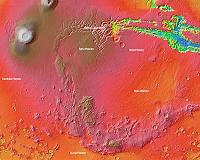
Thaumasia Planum - see more images and detailed captions here

An ancient mountain range on Mars preserves a complex volcanic and tectonic past imprinted with signs of water and ice interactions.

The images, taken on 9 April by the high-resolution stereo camera on ESA's Mars Express, show the Thaumasia mountains and Coracis Fossae, which fringe the huge Solis Planum volcanic plateau from the south.

The region lies to the south of the vast Valles Marineris canyon system and towering Tharsis volcanoes, and is strongly linked to the tectonic stresses that played out during their formation over 3.5 billion years ago.

As the Tharsis bulge swelled with magma during the planet's first billion years, the surrounding crust was stretched, ripping apart and eventually collapsing into troughs. While Valles Marineris is one of the most extreme results, the effects are still seen even thousands of kilometres away, such as in the Coracis Fossae region observed in this image where near-parallel north-south faults are visible primarily to the left.

Tectonic structures like these can control the movement of magma, heat and water in the subsurface, leading to hydrothermal activity and the production of minerals.

Light-toned deposits, which might be clay minerals formed in the presence of water, stand out in the right part of the colour image and at the rim of the large crater. Similar deposits were identified in the nearby Lampland crater.

There is also evidence for valley formation by groundwater erosion and surface runoff occurring at the same time as when the active tectonics shaped the landscape. The water-based erosion means the troughs have been partially buried and heavily modified.

The region was later modified by glacial processes, seen in the flow-like lineated patterns in the flat floors of the large craters.

As a representative of the ancient highlands of Mars, this region holds a wealth of information about the Red Planet's geological history.

MARSDAILY
Swirling spirals at the north pole of Mars
Paris (ESA) Feb 03, 2017
A new mosaic from ESA's Mars Express shows off the Red Planet's north polar ice cap and its distinctive dark spiralling troughs. The mosaic was generated from 32 individual orbit 'strips' captured between 2004 and 2010, and covers an area of around a million square kilometres. The ice cap is a permanent fixture, but in the winter season - as it is now in early 2017 - temperatures are cold ... read more

Related Links
Mars Express
Mars News and Information at MarsDaily.com
Lunar Dreams and more

Comment using your Disqus, Facebook, Google or Twitter login.

Share this article via these popular social media networks
del.icio.usdel.icio.us DiggDigg RedditReddit GoogleGoogle

MARSDAILY
Astronauts to bring asteroid back into lunar orbit

NASA studies tethered CubeSat mission to study Lunar swirls

Florida startup boldly sets sights on moon

Moon could be wetter than thought, say scientists

MARSDAILY
China develops sea launches to boost space commerce

Chinese satellite Zhongxing-9A enters preset orbit

Chinese Space Program: From Setback, to Manned Flights, to the Moon

Chinese Rocket Fizzles Out, Puts Other Launches on Hold

MARSDAILY
Asteroid to shave past Earth on Oct 12: ESA

How to watch this weekend's Perseid meteor shower

SwRI part of international team identifying primordial asteroids

Supernova-Hunting Team Finds Comet with Aid of Amateur Astronomer

MARSDAILY
Twilight observations reveal huge storm on Neptune

Scientists predict chemicals hiding beneath Neptune's icy surface

Jovian storm looms large in the Jupiter's High North

New Horizons Video Soars over Pluto's Majestic Mountains and Icy Plains

MARSDAILY
NASA finds moon of Saturn has chemical that could form 'membranes'

ALMA confirms complex chemistry in Titan's atmosphere

Saturn surprises as Cassini continues its Grand Finale

Titan's calm lakes offer space probes a smooth landing

MARSDAILY
Upper Atmospheric Mission SPORTs an Aerospace Sensor

Lockheed Martin Will Build New Space Instrument Focused on Vegetation Health and Carbon Monitoring

Nickel key to Earth's magnetic field, research shows

NOAA's GOES-S and GOES-T satellites coming together

MARSDAILY
A look inside the Space Station's experimental BEAM module

Two Voyagers Taught Us How to Listen to Space

NASA Offers Space Station as Catalyst for Discovery in Washington

Voyager spacecraft still in communication 40 years out into the void

MARSDAILY
NASA hiring a planetary protection officer to guard against alien invaders

Scientists find four Earth-like exoplanets orbiting closest sun-like star

TRAPPIST-1 twice as old as our solar system

A New Search for Extrasolar Planets from the Arecibo Observatory