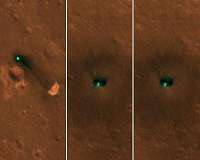
Houston, there is no problem here. Eric Pilles assisted in capturing – for the first-time ever – extraordinary and highly significant scientific images of the NASA InSight robotic lander using HiRISE (High Resolution Imaging Science Experiment), the camera currently monitoring the Red Planet aboard the Mars Reconnaissance Orbiter.
A rising star at Western University's Centre for Planetary Science and Exploration (CPSX), Pilles started his academic career in economic geology but has since transitioned into planetary sciences now as a postdoctoral associate under the supervision of Livio Tornabene and CPSX Director Gordon Osinski.
Tornabene, an Adjunct Professor in Western's Department of Earth Sciences, is a long-time scientific team member of HiRISE, which is based at the University of Arizona's Lunar and Planetary Laboratory.
HiRISE team members take turns leading the scientific planning of image captures and this marks the eighth time Tornabene has supervised a two-week imaging 'cycle' from Western. Tornabene always includes students in the process, allowing new planetary scientists like Pilles an incredible opportunity to collaborate with the very best minds in space exploration while using the very best tools and technology.
"While the knowledge gained on space missions like HiRISE is vital to understanding Earth and its place in the universe, it's equally important for mission veterans like myself to train the next generation of planetary scientists," says Tornabene, who personally recommended Pilles for leading the science planning of the current HiRISE cycle.
"Canada was the third country in space and collectively, we have invaluable experience and knowledge to share, which is why it's so important that we continue to support space research in Canada financially, functionally and fundamentally."
Pilles, who participated in Western's first HiRISE cycle in 2014, worked directly with University of Arizona-based HiRISE Targeting Specialist Kristin Block to capture the full-colour HiRISE image of InSight, which was officially revealed today at the American Geophysical Union Fall Meeting being held in Washington, D.C., with Osinski in attendance.
NASA InSight successfully landed on Mars on Monday, November 26. The HiRISE image compilation released today shows the NASA InSight robotic lander, as well as other hardware needed for entry, descent and landing (EDL).
In the compilation, it appears that the heat shield (upper right) has its dark outside facing down, since it is so bright, likely due to a specular reflection. The lander (middle) disturbed dust over a fair distance and has darkened the surface, as seen previously at both the Phoenix and Curiosity landing sites.
The bright spot associated with the lander itself is probably another specular reflection, and there are two smaller dark, bluish extensions that are the solar arrays, plus their even darker shadows.
The backshell attached to the parachute (lower left) may show yet another specular reflection; the streak extending to the south well beyond the parachute is probably a pre-existing dust devil track. The lander is approximately six meters wide when the solar arrays are fully deployed.
Western's contributions to the 315th HiRISE cycle, planned in part at the CPSX Mission Control facility in Western's Department of Physics and Astronomy, will result in 271 new images of Mars. The current cycle continues through December 22. Pilles and Tornabene are joined on the current mission by PhD candidate Shannon Hibbard and Department of Earth Sciences Adjunct Professor and Research Engineer Matthew Bourassa.