
MARSDAILY
Planet-Encircling Dust Storm of Mars shows signs of slowing
by Staff Writers
Pasadena CA (JPL) Aug 15, 2018

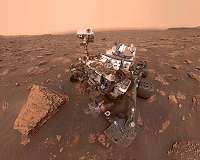
illustration only

The planet-encircling dust storm on Mars continues to show indications of decay.

Dust-lifting sites have decreased and surface features are starting to emerge. There are indications that the atmospheric opacity might be decreasing over the Opportunity site. Since the last contact with the rover on Sol 5111 (June 10, 2018), Opportunity has likely experienced a low-power fault and perhaps, a mission-clock fault. Additionally, the up-loss timer has also since expired, resulting in another fault condition.

The science team is continuing to listen every day for the rover, either during the expected fault communication windows, or listening over a broader range of times using the Deep Space Network Radio Science Receiver. The science team is also sending a command three times a week, to elicit a beep if the rover happens to be awake.

The science team does not expect to hear anything from Opportunity until there has been a significant reduction in the atmospheric opacity over the rover site.

Total odometry is 28.06 miles (45.16 kilometers).


Related Links
Opportunity Archive
Mars News and Information at MarsDaily.com
Lunar Dreams and more

MARSDAILY
Still no change in Opportunity's status
Pasadena CA (JPL) Aug 08, 2018
There is no news since the last status update. As reported last week, the planet-encircling dust storm on Mars is showing indications of peaking and perhaps decaying. Dust lifting sites have decreased in extent and some surface features are starting to become visible. The storm has sustained high atmospheric opacity conditions over the Opportunity site, although there are some preliminary indications that the opacity might be decreasing there. Since the last contact with the rover on S ... read more

Comment using your Disqus, Facebook, Google or Twitter login.

Share this article via these popular social media networks
del.icio.usdel.icio.us DiggDigg RedditReddit GoogleGoogle

MARSDAILY
India's Second Moon Mission as "Complex" as NASA's Apollo Mission

At 60, NASA shoots for revival of moon glory days

MIDAS cameras spot pair of lunar flashes caused by meteoroid impacts

Russia may use ISS Modules in Lunar Gateway Project

MARSDAILY
China to launch space station Tiangong in 2022, welcomes foreign astronauts

China's SatCom launch marketing not limited to business interest

China solicits international cooperation experiments on space station

Growing US unease with China's new deep space facility in Argentina

MARSDAILY
"Great Show" predicted for Perseid meteor peak on August 12-13

Researchers at the University of New Mexico uncover remnants of early solar system

The Umov Effect: Space dust clouds and the mysteries of the universe

Earth mini-moons: Potential for exciting scientific and commercial opportunities

MARSDAILY
Study helps solve mystery under Jupiter's coloured bands

Million fold increase in the power of waves near Jupiter's moon Ganymede

New Horizons team prepares for stellar occultation ahead of Ultima Thule flyby

High-Altitude Jovian Clouds

MARSDAILY
Cassini data yields super sharp infrared images of Titan

Listen: Sound of Electromagnetic Energy Moving Between Saturn, Enceladus

Signatures of complex organic molecules spotted on Saturn's moon Enceladus

Complex organics bubble up from ocean-world Enceladus

MARSDAILY
New satellite map shows ground deformation after Indonesian quake

Planetary Defense Has New Tool in Weather Satellite Lightning Detector

Aeolus sealed from view

PlanetWatchers Launches Foresights Analytics Platform to Advance Commercial Forestry

MARSDAILY
NASA makes progress toward planetary science decadal priorities

Recipe for a spacewalk

ISS end-of-life options

NASA announces new partnerships to develop space exploration technologies

MARSDAILY
Scientist begins developing instrument for finding extraterrestrial bacteria

Tiny tunnels inside garnets appear to be the result of boring microorganisms

Largest haul of extrasolar planets for Japan

Omega Centauri unlikely to harbor life