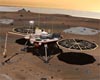
One week after landing on far-northern Mars, NASA Phoenix spacecraft lifted its first scoop of Martian soil as a test of the lander's Robotic Arm.
The practice scoop was emptied onto a designated dump area on the ground after the Robotic Arm Camera photographed the soil inside the scoop. The Phoenix team plans to have the arm deliver its next scoopful, later this week, to an instrument that heats and sniffs the sample to identify ingredients.
A glint of bright material appears in the scooped up soil and in the hole from which it came. "That bright material might be ice or salt. We're eager to do testing of the next three surface samples collected nearby to learn more about it," said Ray Arvidson of Washington University in St. Louis, Phoenix co-investigator for the Robotic Arm.
The camera on the arm examined the lander's first scoop of Martian soil. "The camera has its own red, green and blue lights, and we combine separate images taken with different illumination to create color images," said the University of Arizona's Pat Woida, senior engineer on the Phoenix team.
earlier related report
NASA's Phoenix Lander Makes an Impression on Mars
NASA's Phoenix Mars Lander reached out and touched the Martian soil for the first time on Saturday, May 31, the first step in a series of actions expected to bring soil and ice to the lander's experiments.
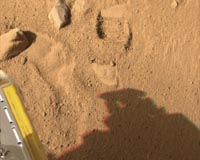
The lander's Robotic Arm scoop left an impression that resembles a footprint at a place provisionally named Yeti in the King of Hearts target zone, away from the area that eventually will be sampled for evaluation.
The impression in the soil was captured by Phoenix's Stereo Surface Imager. Features and locations around the Phoenix lander are being named for fairy tale and mythological characters.
"This first touch allows us to utilize the Robotic Arm accurately. We are in a good situation for the upcoming sample acquisition and transfer," said David Spencer, Phoenix's surface mission manager from NASA's Jet Propulsion Laboratory in Pasadena, Calif.
Phoenix's Robotic Arm Camera also took a number of images of the "Snow Queen" site of what is believed to be exposed ice under the lander.
"What we see in the images is in agreement with the notion that it may be ice, and we suspect we will see the same thing in the digging area," said Uwe Keller, Robotic Arm Camera lead scientist from the Max Planck Institute for Solar System Research, Katlenburg-Lindau, Germany
 del.icio.us
 Digg
Digg Reddit
 YahooMyWeb
 Google
 Facebook