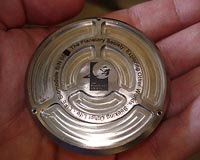
The LIFE module: The Phobos LIFE biomodule used in impact and vibration tests. The outer shell is made of titanium. Credit: Bruce Betts/The Planetary Society
The LIFE module: The Phobos LIFE biomodule used in impact and vibration tests. The outer shell is made of titanium. Credit: Bruce Betts/The Planetary Society |
Due to the relative orbits of Earth and Mars, favorable launch opportunities to the Martian system occur only every 26 months. So missing the 2009 opportunity delays us to 2011. Mars mission delays are not uncommon, and in fact seem more the norm than the exception these days.
In December last year, NASA decided upon a similar delay for its Mars Science Laboratory mission from 2009 to 2011, and ESA has delayed its ExoMars lander several times: it is now slated for 2018.
In recent months, the Phobos Grunt mission team has been making every effort to meet the October 2009 launch period, and that included The Planetary Society's piece - LIFE - which was delivered and integrated into the spacecraft this summer.
More recently, the fully integrated spacecraft has been undergoing testing at NPO Lavochkin, the industrial organization where the spacecraft is being built. It appears that those tests could not be completed in time to assure the spacecraft's readiness for launch.
Though human nature makes us want to fly the LIFE experiment sooner rather than later, we recognize it is far more important to take the time to prepare a successful mission.
Our Phobos LIFE team has one flight biomodule and three duplicate Earth control biomodules that are fully loaded with the micro-organisms that were chosen to fly to Phobos and back. When it does fly, LIFE will help us to understand one aspect of transpermia, whether life can be transported between the planets.
Phobos LIFE will test for the first time whether life can survive the deep space environment for a multi-year duration, acting as a simulated meteoroid with organisms inside. Phobos Grunt is the only currently scheduled deep space sample return mission from any space agency and will provide us with a remarkable opportunity to conduct the LIFE experiment.
For now, the LIFE biomodules will remain sealed while the Phobos LIFE science team decides what to do with them over the next two years. The current biomodules provide an opportunity to get science data during this time on the ground to better anticipate and interpret results from our eventual spaceflight.
At this time, we anticipate loading new organisms into a flight module in 2011 for launch on Phobos Grunt, focusing the experiment on the time the organisms are in space. However, the science team will consider all options over the coming weeks and months.
We thank our Planetary Society members, donors, and partners on the Phobos LIFE project for making this possible, and for their understanding of the nature of the space business which can lead to delays like this one. By its nature, spaceflight is risky and challenging.
When Phobos LIFE does launch, it will be a fascinating and important test of life's ability to move bet
Share This Article With Planet Earth
 del.icio.us del.icio.us |
 Digg Digg |
 Reddit Reddit |
 YahooMyWeb YahooMyWeb |
 Google Google |
 Facebook Facebook |

 US Clears ISRO Launch Of Algerian Satellites
| The content herein, unless otherwise known to be public domain, are Copyright 1995-2009 - SpaceDaily. AFP and UPI Wire Stories are copyright Agence France-Presse and United Press International. ESA Portal Reports are copyright European Space Agency. All NASA sourced material is public domain. Additional copyrights may apply in whole or part to other bona fide parties. Advertising does not imply endorsement,agreement or approval of any opinions, statements or information provided by SpaceDaily on any Web page published or hosted by SpaceDaily. Privacy Statement |