
MARSDAILY
Opportunity's Science Team Remains Vigilant
by Staff Writers
Pasadena CA (JPL) Jul 19, 2018

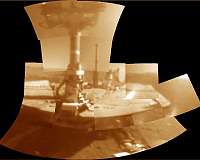
Oppy on a better day.

The dust storm on Mars is continuing as a Planet-encircling Dust Event (PEDE) with no indication of receding at this time.

The storm has sustained high atmospheric opacity conditions over the Opportunity site for several weeks without any change. There is no indication at this time of the storm abating or clearing.

Since the last contact with the rover on Sol 5111 (June 10, 2018), it is likely that Opportunity has experienced a low-power fault, putting herself to sleep only to wake when the skies eventually clear.

If the atmospheric opacity or the solar array dust factor has gotten worse since the last contact, Opportunity could also experience a mission clock fault.

Furthermore, the rover uploss timer duration has expired. So, when the rover wakes it will also declare an uploss timer fault. It will be important for the science team to carefully unpack all these fault modes when they proceed with recovery efforts.

For now, the science team is listening every day for the rover during both the time of low-power and uploss fault communication windows and listening over a broader range of times under mission clock fault.

The science team is using the services of the Deep Space Network (DSN) Radio Science Receiver (RSR) to listen even when they do not have a schedule track and the RSR is now listening on both left- and right-hand circular polarizations (LCP and RCP) when possible.

Continuing for the near term, the science team is also sending a command to elicit a beep if the rover happens to be awake.

The team does not expect to hear anything from Opportunity until there has been a significant reduction in the storm and the associated atmospheric opacity over the rover site. However, they remain vigilant.

Total odometry is 28.06 miles (45.16 kilometers).


Related Links
Opportunity Archive at JPL
Mars News and Information at MarsDaily.com
Lunar Dreams and more

MARSDAILY
NASA listens out for Opportunity everyday
Pasadena CA (JPL) Jul 09, 2018
The dust storm on Mars is continuing as a Planet-encircling Dust Event (PEDE) with no indication of receding at this time. Again, since the last contact with the rover on Sol 5111 (June 10, 2018), it is likely that Opportunity has experienced a low-power fault, putting herself to sleep only to wake when the skies eventually clear. Also, if the atmospheric opacity or the solar array dust factor has gotten worse since the last contact, Opportunity could also experience a mission clock fault. ... read more

Comment using your Disqus, Facebook, Google or Twitter login.

Share this article via these popular social media networks
del.icio.usdel.icio.us DiggDigg RedditReddit GoogleGoogle

MARSDAILY
Russia may use ISS Modules in Lunar Gateway Project

Israel plans its first moon launch in December

The toxic side of the Moon

Waystation to the Solar System

MARSDAILY
PRSS-1 Satellite in Good Condition

China readying for space station era: Yang Liwei

China launches new space science program

China Rising as Major Space Power

MARSDAILY
NASA's Dawn spacecraft focused on Ceres as it nears end of mission

Observatories Team Up to Reveal Rare Double Asteroid

ATLAS Telescope Pinpoints Meteorite Impact Prediction

Dusk for Dawn: Mission of many firsts to gather more data in home stretch

MARSDAILY
Dozen new Jupiter moons declared

NASA Juno data indicate another possible volcano on Jupiter moon Io

First Global Maps of Pluto and Charon from New Horizons Published

Europa's Ocean Ascending

MARSDAILY
Listen: Sound of Electromagnetic Energy Moving Between Saturn, Enceladus

Signatures of complex organic molecules spotted on Saturn's moon Enceladus

Complex organics bubble up from ocean-world Enceladus

Surprising magnetic reconnection spotted on Saturn's dayside

MARSDAILY
MetOp-C launch campaign kicks off

Aist-2D high resolution images received

What does global climate have to do with erosion rates?

Copernicus Sentinel-5P releases first data

MARSDAILY
Scientists Can Now Recycle Water, Air, Fuel, Making Deep Space Travel Possible

First space tourist flights could come in 2019

NASA and Peanuts Worldwide to Collaborate on Deep Space Learning Activities

Russian cargo ship docks at ISS in record time

MARSDAILY
Astronomers find a famous exoplanet's doppelganger

Finding a Planet with a 10-Year Orbit in a Few Months

TESS Spacecraft Continues Testing Prior to First Observations

NASA's Webb Space Telescope to Inspect Atmospheres of Gas Giant Exoplanets