Image Credit: NASA/JPL-Caltech/Cornell.
Image Credit: NASA/JPL-Caltech/Cornell. |
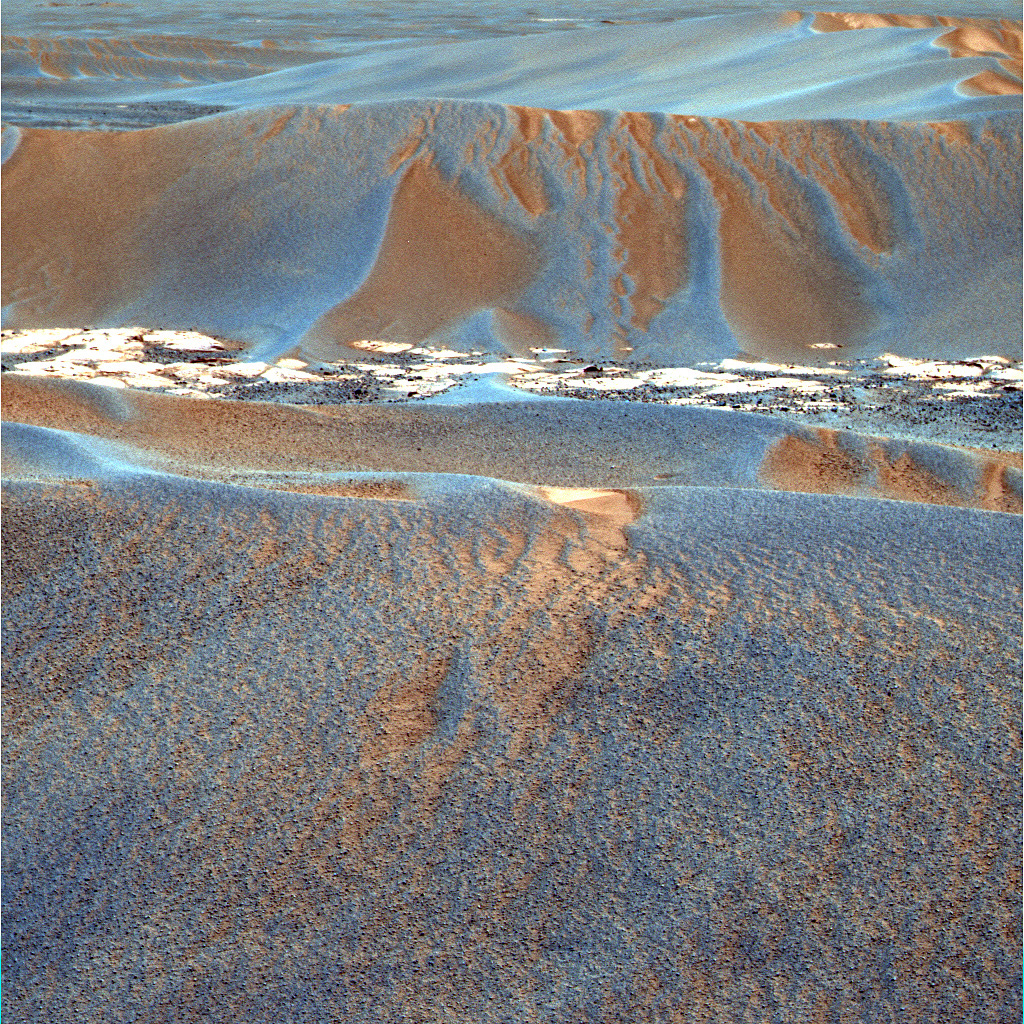
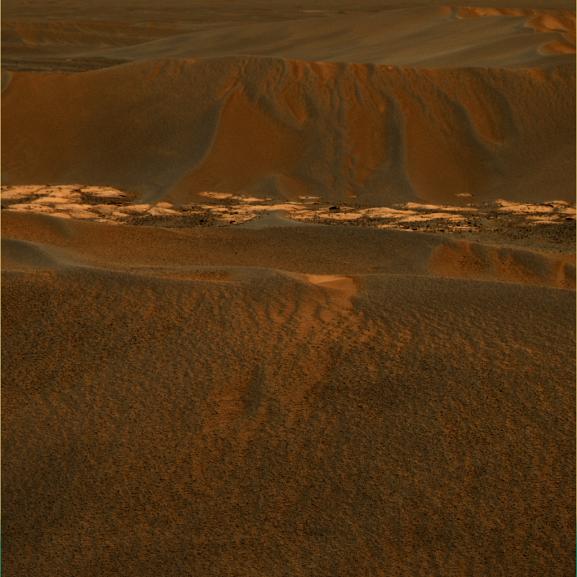
The view looks towards the east, covering a large wind-blown ripple called "Scylla", and other nearby ripples and patches of brighter rock strewn with dark cobbles.
Panoramic camera bands L4 (601-nanometer wavelength), L5 (535 nanometers), and L6 (482 nanometers) correspond to red, green, and blue bands in the false-color image.
The blue-tinted colors associated with the scours and ripple crests are probably due to the presence of basaltic sands mixed with hematite-rich spherules. Color patterns on the larger ripple flanks are caused by different amounts of reddish dust.
The larger ripple flanks have an intricate mixture of erosional scours and secondary ripples extending downward from the main ripple crests, suggesting that these ripples have most recently encountered a period of wind erosion and transport of their outer layers.
For comparison, the same panoramic camera image is shown, but in this case rendered as an approximately true-color composite.
Community
 Spirit Heading To 'Home Plate'
 Pasadena CA (JPL) Jan 09, 2006
| The content herein, unless otherwise known to be public domain, are Copyright 1995-2006 - SpaceDaily.AFP and UPI Wire Stories are copyright Agence France-Presse and United Press International. ESA PortalReports are copyright European Space Agency. All NASA sourced material is public domain. Additionalcopyrights may apply in whole or part to other bona fide parties. Advertising does not imply endorsement,agreement or approval of any opinions, statements or information provided by SpaceDaily on any Web page published or hosted by SpaceDaily. Privacy Statement |