
MARSDAILY
Opportunity team continues studies on origin of 'Perseverance Valley'
by Staff Writers
Pasadena CA (JPL) May 14, 2018

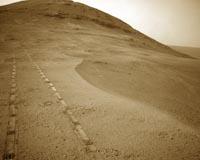
illustration only

Opportunity is only halfway down in "Perseverance Valley" on the west rim of Endeavour crater, pursuing several scientific hypotheses as to the origin of the valley including both water and wind erosion.

The next objective is to investigate some tabular rocks up close that are of interest to the science team. On Sol 5074 (May 3, 2018), Opportunity backed up about 6.07 feet (1.85 meters) to set up for an approach to the tabular rock targets. On Sol 5076 (May 5, 2018), the rover moved forward just over 9.8 feet (3 meters) in an approach to those rocks.

At this new location, Opportunity collected both Navigation Camera (Navcam) and Panoramic Camera (Pancam) panoramas to establish the context. An atmospheric argon measurement was performed overnight by the Alpha Particle X-ray Spectrometer (APXS).

Sol 5079 (May 8, 2018) began the in-situ (contact) investigation of the tabular rock target called "Inde." The robotic arm (IDD) was used to first collect a Microscopic Imager (MI) mosaic of the target, then the APXS was placed on the same for a multi-hour integration to measure the elemental chemistry.

As of Sol 5079 (May 8, 2018), the solar array energy production was 667 watt-hours with an atmospheric opacity (Tau) of 0.619 and a solar array dust factor of 0.776.

Total odometry is 28.06 miles (45.16 kilometers).


Related Links
Opportunity
Mars News and Information at MarsDaily.com
Lunar Dreams and more

MARSDAILY
Opportuity Mars rover looking for a path of less resistance
Pasadena CA (JPL) Apr 25, 2018
Opportunity is continuing the exploration of "Perseverance Valley" on the west rim of Endeavour Crater, pursuing several scientific hypotheses as to the origin of the valley. The rover is positioned about halfway down the approximately 656 feet (200-meter) valley near an apparent flow stream island. Opportunity is finishing up some in-situ (contact) investigations of local outcrops. However, tabular rocks a few feet upslope have become of great interest to the science team. On Sol 5053 (Apri ... read more

Comment using your Disqus, Facebook, Google or Twitter login.

Share this article via these popular social media networks
del.icio.usdel.icio.us DiggDigg RedditReddit GoogleGoogle

MARSDAILY
Take me to the Moon

Russian cosmonaut could ride US spacecraft to Moon for first mission

NASA expands plans for Moon exploration

Lunar Orbital Platform Gateway is First Step Towards Mars - ESA Coordinator

MARSDAILY
China to Use Soviet Engine to Power Its First Reusable Space Rocket

Astronauts eye more cooperation on China's space station

China unveils underwater astronaut training suit

China to launch advanced space cargo transport aircraft in 2019

MARSDAILY
Asteroid Institute Announces Program with York Space Systems to Explore Low-Cost Space-Based Asteroid Tracking System

Exiled Asteroid Discovered in Outer Reaches of Solar System

Projectile cannon experiments show how asteroids can deliver water

Lyrid meteor shower to peak over the weekend

MARSDAILY
New views of Jupiter" showcases swirling clouds on giant planet

Fresh results from NASA's Galileo spacecraft 20 years on

What do Uranus's cloud tops have in common with rotten eggs?

Pluto's Largest Moon, Charon, Gets Its First Official Feature Names

MARSDAILY
MARSDAILY
NASA Spacecraft Discovers New Magnetic Process in Turbulent Space

New research reveals how energy dissipates outside Earth's magnetic field

CryoSat reveals retreat of Patagonian glaciers

Moon holds key to improving satellite views of Earth

MARSDAILY
Russia Offers Space Tourist Flight to US, European Astronauts, UAE Citizen

The challenge of space gardening: One giant 'leaf' for mankind

Tourism nearly a tenth of global CO2 emissions

Jim Bridenstine brings understanding of commercial technology to his new role as NASA Admin

MARSDAILY
Atmospheric seasons could signal alien life

Dutch astronomers photograph possible toddler planet by chance

ANU study sheds new light on how our solar system formed

The Cheops ccience instrument arrives in Madrid