 |
 |
 |
 |
 |
 |
 |
 |
 |

 |
New Horizons Slips Into Electronic Slumber
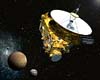
Washington DC (SPX) Jun 29, 2007 New Horizons' first operational hibernation phase is off to a successful start! On commands transmitted from the Mission Operations Center at Johns Hopkins Applied Physics Laboratory (APL) in Maryland, through NASA's Deep Space Network, the spacecraft eased into hibernation mode in the early hours of June 27. Since then, New Horizons has twice broadcast "green" beacon tones back to Earth, indicating all systems are healthy and operating as programmed. Hibernation - in which the spacecraft's redundant components and guidance and control system are powered off - is designed to reduce wear and tear on spacecraft electronics, lessen spacecraft-operation costs and free up Deep Space Network tracking resources for other missions. New Horizons will "sleep" in this spin-stabilized state for most of the remaining 8-year cruise to Pluto; operators will wake New Horizons for about two months out of each year for system checkouts and instrument calibrations. During hibernation, New Horizons' onboard flight computer monitors system health and broadcasts a beacon tone through the medium-gain antenna. New Horizons will transmit a "green" coded tone if all is well, or a "red" tone if it detects a problem and requires help from the operations team. New Horizons is the first mission to make operational use of hibernation in flight and the associated beacon communications mode. "We're looking forward to an uneventful spacecraft slumber," says New Horizons Mission Operations Manager Alice Bowman, of APL. She adds that to be sure everything is nominal, the team will check in on New Horizons seven times during this hibernation period, which lasts two weeks. Community Email This Article Comment On This Article Related Links New Horizons at APL The million outer planets of a star called Sol
 Nap Before You Sleep For Your Cruise Into The Abyss Of Outer Sol
 Washington DC (SPX) Jun 21, 2007
Since I last wrote in mid-May, New Horizons has continued its traverse down the magnetotail of Jupiter. That final phase of our Jupiter flyby science will conclude tomorrow, on June 21. At that point, we will be 1.25 astronomical units, or about 120 million miles, from Jupiter. (For Jupiter aficionados, that's about 2,300 Jupiter radii from the planet). |
|
|

| The content herein, unless otherwise known to be public domain, are Copyright 1995-2006 - SpaceDaily.AFP and UPI Wire Stories are copyright Agence France-Presse and United Press International. ESA PortalReports are copyright European Space Agency. All NASA sourced material is public domain. Additionalcopyrights may apply in whole or part to other bona fide parties. Advertising does not imply endorsement,agreement or approval of any opinions, statements or information provided by SpaceDaily on any Web page published or hosted by SpaceDaily. Privacy Statement |