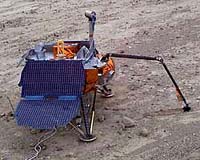
File image of Phoenix engineering test model undergoing testing in Death Valley California.
File image of Phoenix engineering test model undergoing testing in Death Valley California. |
First, however, it must launch from Florida during a three-week period beginning Aug. 3, then survive a risky descent and landing on Mars next spring.
"Our 'follow the water' strategy for exploring Mars has yielded a string of dramatic discoveries in recent years about the history of water on a planet where similarities with Earth were much greater in the past than they are today," said Doug McCuistion, director of the Mars Exploration Program at NASA Headquarters, Washington. "Phoenix will complement our strategic exploration of Mars by being our first attempt to actually touch and analyze Martian water -- water in the form of buried ice."
NASA's Mars Odyssey orbiter found evidence in 2002 to support theories that large areas of Mars, including the arctic plains, have water ice within an arm's reach of the surface.
"Phoenix has been designed to examine the history of the ice by measuring how liquid water has modified the chemistry and mineralogy of the soil," said Peter Smith, the Phoenix principal investigator at the University of Arizona, Tucson.
"In addition, our instruments can assess whether this polar environment is a habitable zone for primitive microbes. To complete the scientific characterization of the site, Phoenix will monitor polar weather and the interaction of the atmosphere with the surface."
With its flanking solar panels unfurled, the lander is about 18 feet wide and 5 feet long. A robotic arm 7.7 feet long will dig to the icy layer, which is expected to lie within a few inches of the surface. A camera and conductivity probe on the arm will examine soil and any ice there. The arm will lift samples to two instruments on the lander's deck. One will use heating to check for volatile substances, such as water and carbon-based chemicals that are essential building blocks for life. The other will analyze the chemistry of the soil.
A meteorology station, with a laser for assessing water and dust in the atmosphere, will monitor weather throughout the planned three-month mission during Martian spring and summer. The robot's toolkit also includes a mast-mounted stereo camera to survey the landing site, a descent camera to see the site in broader context and two microscopes.
For the final stage of landing, Phoenix is equipped with a pulsed thruster method of deceleration. The system uses an ultra-lightweight landing system that allows the spacecraft to carry a heavier scientific payload. Like past Mars missions, Phoenix uses a heat shield to slow its high-speed entry, followed by a supersonic parachute that further reduces its speed to about 135 mph. The lander then separates from the parachute and fires pulsed descent rocket engines to slow to about 5.5 mph before landing on its three legs.
"Landing safely on Mars is difficult no matter what method you use," said Barry Goldstein, the project manager for Phoenix at NASA's Jet Propulsion Laboratory, Pasadena, Calif. "Our team has been testing the system relentlessly since 2003 to identify and address whatever vulnerabilities may exist."
Researchers evaluating possible landing sites have used observations from Mars orbiters to find the safest places where the mission's goals can be met. The leading candidate site is a broad valley with few boulders at a latitude equivalent to northern Alaska.
Smith leads the Phoenix mission, with project management at the Jet Propulsion Laboratory and the development partnership located at Lockheed Martin, Denver. International contributions are provided by the Canadian Space Agency, the University of Neuchatel, Switzerland, the University of Copenhagen, Denmark, the Max Planck Institute, Germany, and the Finnish Meteorological Institute.
Community
 Scientists Find That Earth And Mars Are Different To The Core
 Oxford UK (SPX) Jul 06, 2007
| The content herein, unless otherwise known to be public domain, are Copyright 1995-2006 - SpaceDaily.AFP and UPI Wire Stories are copyright Agence France-Presse and United Press International. ESA PortalReports are copyright European Space Agency. All NASA sourced material is public domain. Additionalcopyrights may apply in whole or part to other bona fide parties. Advertising does not imply endorsement,agreement or approval of any opinions, statements or information provided by SpaceDaily on any Web page published or hosted by SpaceDaily. Privacy Statement |