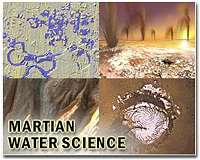
Mars is too cold to host flowing liquid water, but with the right mix of compounds, a water solution could be hiding on and below Mars' surface.
New research suggests a solution dubbed "mimetic Martian water" could flow on and beneath the Red Planet's crust. Such a solution could explain the channeling, riveting and other evidence of weathering observed on the Martian surface.
But the experiments also suggest such a water solution would be highly pressurized.
Martian soil samples collected by NASA's Phoenix Lander in 2009 revealed the presence of calcium and magnesium perchlorate, a powerful oxidant.
"The discovery of significant amounts of different perchlorate salts in Martian soil gives new insight into the Martian 'riverbeds,'" Lorna Dougan, researcher at the University of Leeds, said in a news release.
The average surface temperature on Mars is -55 degrees Celsius.
"Water itself cannot exist as a liquid on Mars, but concentrated solutions of perchlorate could survive these low temperatures," Dougan said.
Dougan and her colleagues conduct a variety of experiments and ran computer models to determine what the structure of mimetic Martian water would look like. Their analysis — detailed this week in the journal Nature Communications — proved perchlorate has a dramatic impact on water's structure.
The addition of perchlorate has the effect of subjecting water molecules to 2 billion pascals or more of pressure. As a result of the intense pressure, ions in the solution become partially segregated. Scientists hypothesize that this segregation prevents the solution from freezing.
"The magnesium perchlorate is clearly a major contributing factor on the freezing point of this solution and paves the way for understanding how a fluid might exist under the sub-freezing conditions of Mars," Dougan said.
What's more, if there is life on Mars, the latest research suggests scientists should look for organisms uniquely adapted to high-pressure environments — such as microbes found deep in Earth's oceans.
"This highlights the importance of studying life in extreme environments in both terrestrial and non-terrestrial environments so that we can fully understand the natural limits of life," Dougan said.
Methane belches kept water flowing on ancient Mars
Frequent belches of methane could explain how a younger Mars maintained liquid water on its surface despite a cold, arid climate.
The evidence that water once flowed freely on Mars is overwhelming. Over the last decade, scientists have found signs that water moved across the surface of the Red Planet as recently as 3 billion years ago.
The problem is, scientists have also uncover … read more