Hardware installed onto NASA's Mars 2020 entry vehicle this week will help to increase the safety of future Mars landings.
Charged with returning astronauts to the Moon by 2024, NASA's Artemis lunar exploration plans will establish a sustained human presence on and around the Moon by 2028. NASA will use its Moon missions along with robotic missions to Mars to prepare for human exploration of the Red Planet.
The Mars Entry, Descent and Landing Instrumentation 2 (MEDLI2) project developed a suite of sensors that will measure aerothermal environments and the performance of thermal protection system (TPS) material during the entry phase on the Mars 2020 mission.
Engineers installed the first batch of items delivered by MEDLI2 onto the heat shield of the entry vehicle this week. The aeroshell of the entry vehicle consists of a heat shield and backshell and will protect the Mars 2020 rover in transit from Earth to Mars and during the entry through the atmosphere of Mars on its way to the surface.
"Understanding the actual performance of our current generation of entry vehicles is crucial to safe, reliable landing of future robotic and crewed Mars missions. MEDLI2 pressure and thermal measurements are the key to that understanding," said Todd White, MEDLI2 principal investigator.
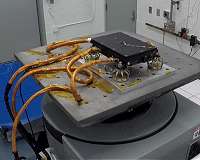
MEDLI2 recently completed environmental testing on flight hardware at NASA's Langley Research Center in Hampton, Virginia. The testing, including vibration and thermal vacuum testing, demonstrates the ability of the hardware to survive the large vibratory loads experienced during the launch and the extreme cold during the cruise to Mars.
High-temperature sterilization of some of the hardware has also been successfully concluded, allowing MEDLI2 to minimize the potential of transporting terrestrial biological material unintentionally to the surface of Mars. All of the MEDLI2 components are set to be completely installed on the Mars 2020 aeroshell by the end of November 2019.
MEDLI2 includes three types of sensors (thermocouples, heat flux sensors and pressure transducers), a data acquisition and signal conditioning unit (the Sensor Support Electronics Unit) to record the heating and atmospheric pressure experienced during entry and through parachute deployment, and the harnessing between the sensors and the Sensor Support Electronics unit.
Building on the first MEDLI suite, which flew on NASA's Mars Science Laboratory mission, instrumentation is again being applied to the heat shield, but in a different configuration to better measure the flow characteristics.
This time instrumentation is being installed on the backshell as well to collect measurements of the heating and the surface pressure to aid in reducing the large uncertainty applied to the current predicted results.
The Mars 2020 spacecraft will enter Mars' atmosphere traveling about 12,500 mph (20,120 kph). MEDLI2 will start to collect data about five hours prior to the entry and continue to collect data throughout the entry and part of the descent phases.
It will take about 6 minutes to slow the spacecraft from 12,500 mph (20,120 kph) to just under 2 mph (3 kph). MEDLI2 will measure crucial entry and descent performance data on the Mars 2020 heat shield and backshell.
MEDLI2 flight data will fill critical space entry, descent and landing knowledge gaps which would advance current EDL technology. This technology also has the potential to reduce TPS mass by up to 35%, which would result in significant cost reductions.
This technology and data will also help reduce the size of the landed footprint (the uncertainty footprint) allowing access to sites with high scientific interest that might otherwise be difficult to reach.
"Uncertainties in our ability to model and predict the performance of an entry vehicle and the associated thermal protection system mean that large margins (100% to 200%) need to be included in our predictions to ensure the entry vehicle can survive the worst case conditions," said Henry Wright, MEDLI2 project manager.
"Flight data will allow the uncertainties in the models to be further reduced leading to a more accurate prediction of the loads and performance."
The key objectives of MEDLI2 are to reduce design margin and prediction uncertainties for the aerothermal environments and aerodynamic database. Close analysis of MEDLI2 flight data is vital to future NASA exploration of the Red Planet. MEDLI2 will explore areas not addressed during the Mars Science Laboratory (MSL) mission and seek answers to questions generated from examining MEDLI/MSL data.
MEDLI2 is a Game Changing Development project led by NASA's Space Technology Mission Directorate with support from the Human Exploration and Operations Mission Directorate and the Science Mission Directorate. The project is managed at Langley and implemented in partnership with NASA's Ames Research Center in California's Silicon Valley and the Jet Propulsion Laboratory in Pasadena, California.