
 |
 |
 |
 |
 |
 |
 |
 |
 |

 |
MARSIS Data Reveal New Method To Measure The Magnetic Field Of Mars
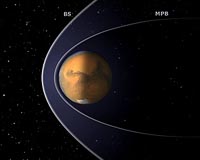
Paris, France (ESA) Sep 25, 2009 Unusual signals detected by the Mars Express MARSIS instrument have been used to determine the magnetic field strength of Mars. In a forthcoming issue of Icarus, Ferzan Akalin and colleagues demonstrate how the MARSIS instrument can be used as a magnetometer - an unexpected application with important consequences for studies of local plasma effects and the Mars Express spacecraft environment. Our current knowledge of the martian magnetic field is based on data gathered by magnetometers on board the many spacecraft that have explored Mars to date, most notably those on the Mars Global Surveyor and Phobos 2 spacecraft. Studies have shown that the magnetic field is variable and dynamic in nature and much still remains to be learned about it. Mars has no strong global magnetic field like that of the Earth. Instead it has a patchy crustal magnetic field originating in locally magnetized regions of the planet's crust. In addition, on the dayside of the planet an induced magnetic field is present. It originates from the magnetic field that is carried by the solar wind which gets compressed at Mars and is draped around the planet. In the absence of a strong global magnetic field, the solar wind interacts directly with the planet's ionized atmosphere (ionosphere). The interaction results in the formation of two clear boundaries: the bow shock and the magnetic pile-up boundary (MPB). At the bow shock the solar wind is decelerated from supersonic to subsonic speed as its flow is obstructed by Mars. Closer to the planet's surface is the MPB, which is the top of the induced magnetic field. Both the crustal and induced magnetic fields play an important factor in the space environment near Mars, as well as its ionosphere. The instrument suite of Mars Express comprises 7 instruments designed to characterise the atmosphere, surface and sub-surface of the planet but does not include a magnetometer.
MARSIS, sounding the ionosphere In ionospheric sounder mode a strong, short duration (91.4 s) radio pulse is transmitted towards the planet by a 40-metre-long electric dipole antenna. The time of arrival of the subsequent echoes - signals reflected by different layers in the ionosphere or from the Martian surface - is recorded and provides a direct measure of the distance travelled by the radio pulse. The pulse is repeated at 160 different frequencies between 0.1 and 5.5 MHz and an ionogram (see Figure 3) is constructed from the measurements from which profiles of the ionosphere or surface can be constructed.
Unexpected echoes - key to measuring the magnetic field strength In an interpretation first put forward by Gurnett et al. (2005), Akalin and colleagues in this study consider these echoes to be the signal from large collections of electrons in the vicinity of the spacecraft that have been collectively accelerated by the strong electric pulse (400 V) of the MARSIS antenna. The electrons subsequently follow a cyclotron orbit in the local magnetic field of Mars. As they return to the antenna after each cycle in their heliacal orbit their collective pulse signal is repeatedly picked up by the antenna. Interpreted this way, the unexpected pulsed echoes - electron cyclotron echoes - provide a direct measure of the local magnetic field strength at the position of the spacecraft; as there is a one-to-one relation between the period of an electron's cyclotron orbit in a magnetic field and the strength of that field. As Mars Express follows its highly elliptical orbit around Mars the magnetic field strength can be mapped at different altitudes and positions over the planet, building up a global picture.
Measuring the dayside induced magnetic field in Mars's ionosphere They show that their method can be used to measure the magnetic field on the dayside of the planet, and they determine the strength of the induced magnetic field at altitudes up to the magnetic pile-up boundary, at which point the magnetic field strength falls below the detection limit of this MARSIS method. The results obtained with MARSIS agree well with previous measurements made with the magnetometer aboard the NASA Mars Global Surveyor mission (for altitude ranges where both mission datasets overlapped). This leads the authors to conclude that the cyclotron interpretation of the regular echoes in the MARSIS data is correct thus providing an unexpected method and valuable tool for measuring the magnetic field strength of Mars. Share This Article With Planet Earth
Related Links Mars Express Mars News and Information at MarsDaily.com Lunar Dreams and more

 AMASE 2009 Expedition Finishes
Moffett Field CA (SPX) Sep 22, 2009 Before we get into the blogs, you may have noticed that we were unable to post everyday while we were aboard Lance. Loss of internet contact is part of an arctic expedition, and we were not able to get the posts out until now that we are off the ship. We may be rocket scientists, but there are things that even this group can't do! So, with apologies for the belatedness of these posts ... read more |
|
|
| The content herein, unless otherwise known to be public domain, are Copyright 1995-2009 - SpaceDaily. AFP and UPI Wire Stories are copyright Agence France-Presse and United Press International. ESA Portal Reports are copyright European Space Agency. All NASA sourced material is public domain. Additional copyrights may apply in whole or part to other bona fide parties. Advertising does not imply endorsement,agreement or approval of any opinions, statements or information provided by SpaceDaily on any Web page published or hosted by SpaceDaily. Privacy Statement |
 del.icio.us
 Digg
Digg Reddit
 YahooMyWeb
 Google
 Facebook