
MARSDAILY
Long Eclipse Avoidance Manoeuvres Performed Successfully on MOM Spacecraft
by Staff Writers
New Delhi, India (SPX) Jan 24, 2017


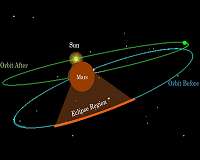
Eclipse Avoidance Manoeuvres on MOM Spacecraft.

An orbital manoeuvres was performed on Mars Orbiter Mission (MOM) spacecraft to avoid the impending long eclipse duration for the satellite. The duration of the eclipse would have been as long as 8 hours in the coming days.

As the satellite battery is designed to handle an eclipse duration of only about 1 Hour 40 minutes, a longer eclipse would have drained the battery beyond the safe limit.

The manoeuvres performed on January 17, 2017 brought down the eclipse duration to zero during this long eclipse period.

On the Evening of January 17, all the eight numbers of 22N thrusters were fired for a duration of 431 seconds, achieving a velocity difference of 97.5 m/s.

This has resulted in a new orbit for the MOM spacecraft, which completely avoids eclipse up to September 2017. About 20 kg propellant was consumed for this manoeuvres leaving another 13 kg of propellant for its further mission life.

The spacecraft health is normal. The next long eclipse period for MOM is expected in the year 2020.


Comment on this article using your Disqus, Facebook, Google or Twitter login.

.


Related Links
Mars Orbiter Mission
Mars News and Information at MarsDaily.com
Lunar Dreams and more


Share this article via these popular social media networks
del.icio.usdel.icio.us DiggDigg RedditReddit GoogleGoogle

Previous Report
MARSDAILY
How on Earth does NASA choose a landing site on Mars?
Pasadena CA (JPL) Dec 16, 2016
Getting to the surface of Mars takes years of planning, engineering and science work, a successful launch, and a months-long journey of millions of miles. You only get one opportunity to touch down at a site on Mars, so it's critical to get it right. "You can't say, 'here are ten different sites, let's go to them,'" said Michael Meyer, the lead scientist for the Mars Exploration Program at NASA ... read more


MARSDAILY
China schedules Chang'e-5 lunar probe launch

India, Israel among five teams fighting for first private Moon landing

The science behind the Lunar Hydrogen Polar Mapper mission

Eugene Cernan, last man to walk on moon, dead at 82

MARSDAILY
China's first cargo spacecraft to leave factory

China launches commercial rocket mission Kuaizhou-1A

China Space Plan to Develop "Strength and Size"

Beijing's space program soars in 2016

MARSDAILY
Station crew get special delivery from Virginia

MARSDAILY
Experiment resolves mystery about wind flows on Jupiter

Public to Choose Jupiter Picture Sites for NASA Juno

Pluto Global Color Map

Lowell Observatory to renovate Pluto discovery telescope

MARSDAILY
Cassini captures stunning view of Saturn moon Daphnis

Catching Cassini's call

Huygens: 'Ground Truth' From an Alien Moon

NASA image showcases Saturn's sun-soaked north pole

MARSDAILY
NASA measures 'dust on snow' to help manage Colorado River Basin water supplies

NOAA's GOES-16 Satellite Sends First Images to Earth

How satellite data changed chimpanzee conservation efforts

Doubt over Everest's true height spurs fresh expedition

MARSDAILY
Scientists and students tackle omics at NASA workshop

Mister Trump Goes to Washington

Airbus delivers propulsion test module for the Orion programme to NASA

NASA to rely on Soyuz for ISS missions until 2019

MARSDAILY
First footage of a living stylodactylid shrimp filter-feeding at depth of 4826m

SF State astronomer searches for signs of life on Wolf 1061 exoplanet

Looking for life in all the right places with the right tool

Could dark streaks in Venusian clouds be microbial life