 |
 |
 |
 |
 |
 |
 |
 |
 |

 |
Latest US Mars Mission Plans Most Detailed Views Of Red Planet Yet Seen
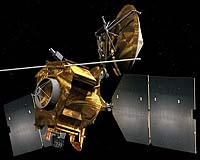
Washington DC (SPX) Aug 09, 2005 The next American mission to Mars is set to launch from Florida soon to examine the red planet in the sharpest detail, yet. The first launch opportunity comes Wednesday, August 10, but can go anytime until the end of the month. The spacecraft will be the largest to circle the planet, with big capabilities to match. The first launch opportunity comes Wednesday, August 10, but can go anytime until the end of the month. The spacecraft will be the largest to circle the planet, with big capabilities to match. Since 1997, the U.S. space agency, NASA, has been dispatching orbiters and companion landers to Mars about every two years, to seek a better geological understanding of Earth's nearest planetary neighbor. It especially wants to learn if conditions ever existed that could have supported life. The next in the series is the huge Mars Reconnaissance Orbiter, two-stories tall and nearly 15-meters wide. The head of NASA's Mars exploration program, Douglas McCuistion says the effort now moves into a more intensive phase of investigation. "So this is a big mission for us. It's big in the strategic role in the Mars exploration program, it's the biggest orbiter sent to Mars in the past 30 years, carrying the most powerful suite of remote sensing instruments ever deployed to another planet," he said. NASA says the Mars Reconnaissance Orbiter will have better capabilities for understanding the red planet's surface, subsurface, and atmosphere than the American and European satellites now orbiting, the two U.S. robotic rovers on the ground, or any previous mission. "It's a weather satellite, it's a geological surveyor, it's a pathfinder for future missions," said NASA project scientist Richard Zurek. He says the new orbiter, known by its English initials MRO, carries six instruments. Some are designed to seek clues to the water most planetary scientists believe once flowed on Mars and is a key to life. They can identify water-related minerals and penetrate the ground about one kilometer to seek layers of rock, ice, and water if it is present. "MRO follows the 'Follow the Water' program by combining global monitoring of the atmosphere and surface, by taking regional surveys of interesting areas, and then zooming in with very high resolution observations of the surface of the planet," said Mr. Zurek. "Together, these data sets provide a new window into Mars' history and they will provide the best sites for future landers to go and explore with some confidence that they are safe sites." The Mars Reconnaissance Orbiter has five times better resolution over more area than its predecessor satellites. It can see things as small as a dinner plate thanks to super-sharp cameras and a planned altitude 20 percent lower than previous spacecraft - about 300 kilometers. "Every time we have increased our ability to resolve detail on the planet, we see new things, and we expect new surprises," said Mr. Zurek. With so much power to collect information, NASA had to give the new spacecraft the means to send huge amounts of it back to Earth, quickly. So the orbiter carries the largest antenna ever sent to Mars, three meters in diameter, and a transmitter powered by large solar panels. The space agency's manager for the project, James Graf, says the data flow will be 10 times per minute higher than previous Mars orbiters. "These other missions have been producing fantastic data, but they have been bringing the data back through, essentially, a straw," he said. "What we are going to do is open the spigot and bring it back through a fire hose. That's crucial if you want to understand Mars. You want to increase the coverage and the resolution of your measurements, so you need that greater data." The Mars Reconnaissance Orbiter is to arrive at its destination in March of next year and begin returning data by the end of the year. First, though, it must gradually adjust its extremely oval orbit to a circular one using atmospheric friction. Its primary data gathering phase is scheduled to last two years, but NASA says it is capable of going for up to a decade. Community Email This Article Comment On This Article Related Links SpaceDaily Search SpaceDaily Subscribe To SpaceDaily Express Mars News and Information at MarsDaily.com Lunar Dreams and more
 Spirit Heading To 'Home Plate'
 Pasadena CA (JPL) Jan 09, 2006
Last week Spirit completed robotic-arm work on "El Dorado." The rover used all three of its spectrometers plus the microscopic imager for readings over the New Year's weekend. |
|
|

| The content herein, unless otherwise known to be public domain, are Copyright 1995-2006 - SpaceDaily.AFP and UPI Wire Stories are copyright Agence France-Presse and United Press International. ESA PortalReports are copyright European Space Agency. All NASA sourced material is public domain. Additionalcopyrights may apply in whole or part to other bona fide parties. Advertising does not imply endorsement,agreement or approval of any opinions, statements or information provided by SpaceDaily on any Web page published or hosted by SpaceDaily. Privacy Statement |