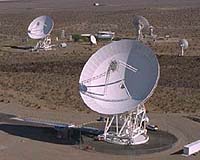
Deep Space Network antennas, illustrating signals being sent to spacecraft. Image credit: NASA/JPL.
Deep Space Network antennas, illustrating signals being sent to spacecraft. Image credit: NASA/JPL. |
Prior to this experiment, only single 34-meter (111- foot) or 70-meter (230-foot) antennas had been used to uplink signals. This is a significant first step for future uplink capabilities using multiple antennas known as arrays.
The recent experiment combined X-band signals from two 34-meter (111-foot) antennas at the Goldstone complex near the Mojave Desert, and transmitted the combined signal to NASA's Mars Global Surveyor spacecraft currently orbiting Mars. The Mars Global Surveyor spacecraft received the combined signal, measured the combined power levels, and verified the predicted power gain, as a result of the combining operation.
The Deep Space Network provides the two-way communications link that guides and controls spacecraft and returns images and other scientific data to Earth. Currently, each Deep Space Network facility has one antenna of 70-meter (230-foot) diameter, between two and seven 34-meter (111-foot) antennas, and one 26-meter (85-foot) antenna. There are three deep-space communications complexes placed approximately 120 degrees apart around the world: at Goldstone in California's Mojave Desert; near Madrid, Spain; and near Canberra, Australia. This configuration ensures that an antenna is always within sight of a given spacecraft, day and night, as Earth rotates.
Although previously downlink arraying has been performed, the lack of a demonstrated ability to perform uplink arraying has limited the potential use of antenna arrays. Antenna arrays have the potential to create an equivalent very large antenna aperture by combining many smaller antennas.
The successful demonstration of uplink arraying is significant because it removes a serious obstacle to moving towards an operational arrayed network for space communications, one that can be used for both uplink and downlink.
Go here for the technical write up on the experiment.
Community
 First HiRISE Images From Mars Due Thursday
 Tucson AZ (SPX) Mar 21, 2006
| The content herein, unless otherwise known to be public domain, are Copyright 1995-2006 - SpaceDaily.AFP and UPI Wire Stories are copyright Agence France-Presse and United Press International. ESA PortalReports are copyright European Space Agency. All NASA sourced material is public domain. Additionalcopyrights may apply in whole or part to other bona fide parties. Advertising does not imply endorsement,agreement or approval of any opinions, statements or information provided by SpaceDaily on any Web page published or hosted by SpaceDaily. Privacy Statement |