MARSDAILY
Deciphering the fluid floorplan of a planet
by Staff Writers
Washington DC (SPX) May 19, 2017


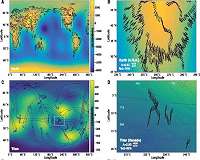
Maps of topography referenced to the geoid and expanded to spherical harmonic degree and order 6, overlain with the fluvial features employed in this study. This material relates to a paper that appeared in the 19 May 2017, issue of Science, published by AAAS. The paper, by B.A. Black at City University of New York in New York, NY, and colleagues was titled, "Global drainage patterns and the origins of topographic relief on Earth, Mars, and Titan." Credit B.A. Black et al., Science (2017)

An assessment of ancient drainage systems on Earth, Mars and Titan provides new insights into the topography-generating mechanisms on planetary bodies. The results illustrate the diverse geological processes affecting these bodies and their river networks.

The movement of liquids such as water across a planetary surface forms rivers, signatures of which can be seen even long after the liquid has disappeared - as with ancient riverbeds formed by water on Mars, for example. Studying these systems can provide valuable insights into the long-term evolution of a planetary body's topography, as the layout of the drainage network depends on whether it formed before, after or at the same time as the topology.

Planetary processes that affect the entire body, such as thermal expansion and contraction, can create "long-wavelength" topographic features that river flow directions will typically correspond with. But planetary bodies may also exhibit "short-wavelength" features such as mountains and volcanic arcs that divert rivers away from the long-wavelength path.

In such cases, downstream flow directions of rivers are not particularly well correlated with the large-scale landscape topography. Benjamin A. Black et al. compared drainage patterns on Earth, Mars and Titan with the short- and long-wavelength features by developing and analyzing two new topographic metrics.

Their technique reveals that drainage systems match better with long-wavelength topography on Titan and Mars than on Earth, where the short-wavelength features dominate. The authors conclude that this is because Earth exhibits active plate tectonics, which continuously generate new short-wavelength features.

The utility of these analyses for understanding the geologic history of planetary bodies is highlighted in an accompanying Perspective by Devon Burr.

Research Report

MARSDAILY
How hard did it rain on Mars
Washington DC (SPX) May 17, 2017
Heavy rain on Mars reshaped the planet's impact craters and carved out river-like channels in its surface billions of years ago, according to a new study published in Icarus. In the paper, researchers from the Smithsonian Institution and the Johns Hopkins University Applied Physics Laboratory show that changes in the atmosphere on Mars made it rain harder and harder, which had a similar effect o ... read more

Related Links
American Association for the Advancement of Science
Mars News and Information at MarsDaily.com
Lunar Dreams and more

Comment using your Disqus, Facebook, Google or Twitter login.

Share this article via these popular social media networks
del.icio.usdel.icio.us DiggDigg RedditReddit GoogleGoogle

MARSDAILY
Winning plans for CubeSats to the Moon

Printing bricks from moondust using the Sun's heat

NASA selects ASU's ShadowCam for moon mission

Russia, US Ready to Give You a Lift to Moon Orbit, ISS

MARSDAILY
A cabin on the moon? China hones the lunar lifestyle

China tests 'Lunar Palace' as it eyes moon mission

China to conduct several manned space flights around 2020

Reach for the Stars: China Plans to Ramp Up Space Flight Activity

MARSDAILY
Movie Shows Ceres at Opposition from Sun

Twisting an Asteroid

Oldest buckthorn fossilized flowers found in Argentina

The Aerospace Corporation leads Asteroid Impact Exercise at IAA in Tokyo

MARSDAILY
Hubble spots moon around third largest dwarf planet

NASA asks science community for Europa Lander Instruments ideas

Waves of lava seen in Io's largest volcanic crater

Not So Great Anymore: Jupiter's Red Spot Shrinks to Smallest Size Ever

MARSDAILY
History of Titan's Landscape Resembles Mars's, not Earth's

Scientists describe origins of topographic relief on Titan

New Movie Shows Cassini's First Dive over Saturn

Cassini Finds 'The Big Empty' Close to Saturn

MARSDAILY
NASA's CPEX tackles a weather fundamental

Earth's atmosphere more chemically reactive in cold climates

First space-based sodium LIRDAR will study poorly understood Mesosphere

NASA Mission Uncovers Dance of Electrons in Space

MARSDAILY
Saving time in space

SpaceX Dragon to deliver research payloads to Space Station

Joint Statement: The Fourth Meeting of the U.S.-Japan Comprehensive Dialogue on Space

'Stone Age' Trump going back to horse and cart says Schwarzenegger

MARSDAILY
Scientists propose synestia, a new type of planetary object

Kepler Telescope Spies Details of Trappist-1's Outermost Planet

Astronomers Confirm Orbital Details of TRAPPIST-1h

Study shows how radioactive decay could support extraterrestrial life