
MARSDAILY
Danish architect envisions life on Mars
by Staff Writers
Dubai (XNA) Feb 14, 2018

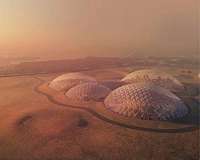
illustration only

Could humans ever live on Mars? Award-winning architect gave a positive answer and even a timescale to this question: in 100 years.

Bjarke Ingels, named by Time magazine in 2016 as among the "100 Most Influential People in the World," said he had already been working at the first step of human's occupation of the planet - a project called Mars Science City.

The 140-million-U.S.-dollar research city is a "viable and realistic model to simulate living on the surface of Mars," according to the government of United Arab Emirates (UAE), which launched the project last year.

"We want to create a prototype where you can experience how it's going to feel like living in Mars, and for education, research and exhibitions," said Ingels, who is also the designer of the project, at the World Government Summit 2018 held in Dubai Monday.

The architect believed that humans would be able to inhabit Mars because of our ingenuity and resolve.

"The timescale for this is that in 99 years, in 2117, we are going to have an Emirates city on Mars," he said.

Once Mars is "colonized," Ingels said, humans could use Mars' natural sources, such as frozen water, sand, rocks and gases in the atmosphere, to create everything from Martian concrete and glass to electronics.

As for the harsh environment that poses challenges to human survival, such as high radiation, the architect suggested that by sleeping underground, it would be possible to reduce radiation levels to less than those experienced by airline crew.

Ingels said by striving to build a "man-made ecosystem" on the Red Planet, humans would have to maximize efficiency and ingenuity in farming, architecture and many other fields. This knowledge and practice would be replicated on Earth to reach a pinnacle in sustainable living, he said.

Source: Xinhua News


Related Links
Mars News
Mars News and Information at MarsDaily.com
Lunar Dreams and more

MARSDAILY
In Oman desert, European venture sets sights on Mars
Dhofar, Oman (AFP) Feb 8, 2018
Would-be astronauts in aluminium-coated suits venture out in rovers from a sprawling camp in Oman's barren desert: a simulation by a European venture aiming to one day help humans survive on Mars. Behind a barbed wire fence protected by soldiers from the Gulf sultanate, researchers in prefab facilities work away on experiments that include trying to grow vegetables in inhospitable terrain chosen for its resemblance to the red planet. Run by the Austrian Space Forum, a mainly volunteer collective ... read more

Comment using your Disqus, Facebook, Google or Twitter login.

Share this article via these popular social media networks
del.icio.usdel.icio.us DiggDigg RedditReddit GoogleGoogle

MARSDAILY
New study sheds light on moon's slow retreat from frozen Earth

India Prepares For Second Lunar Mission with Chandrayaan-2

UCF Seeks New Way to Mine Moon for Water

Chinese volunteers spend 200 days on virtual 'moon base'

MARSDAILY
Chinese taikonauts maintain indomitable spirit in space exploration: senior officer

China launches first shared education satellite

China's first X-ray space telescope put into service after in-orbit tests

China's first successful lunar laser ranging accomplished

MARSDAILY
Seafloor data point to global volcanism after Chicxulub meteor strike

Evidence for a massive biomass burning event at the Younger Dryas Boundary

Two Small Asteroids Safely Pass Earth This Week

New research suggests toward end of Ice Age, human beings witnessed fires larger than dinosaur killers

MARSDAILY
New Horizons captures record-breaking images in the Kuiper Belt

Europa and Other Planetary Bodies May Have Extremely Low-Density Surfaces

JUICE ground control gets green light to start development

New Year 2019 offers new horizons at MU69 flyby

MARSDAILY
Titan topographic map unearths cookie-cutter holes in moon's surface

Cassini finds Titan has 'sea level' like Earth

Giant Storms Cause Palpitations in Saturn's Atmospheric Heartbeat

Electrical and Chemical Coupling Between Saturn and Its Ring

MARSDAILY
Ozone at lower latitudes not recovering, despite ozone hole healing

SSTL and 21AT announce new Earth Observation data contract

NASA Space Sensors to Address Key Earth Questions

Ozone layer declining over populated zones: study

MARSDAILY
ESA and Airbus sign partnership agreement for new ISS commercial payload platform Bartolomeo

All-in-one service for the Space Station

NASA Acting Administrator's Statement on FY 2019 Budget Proposal

US wants to privatize International Space Station: report

MARSDAILY
UChicago astrophysicists settle cosmic debate on magnetism of planets and stars

Viruses are falling from the sky

Are you rocky or are you gassy

What the TRAPPIST-1 Planets Could Look Like