
MARSDAILY
Curiosity Mars rover back on drill duty
by Staff Writers
Pasadena CA (JPL) May 24, 2018

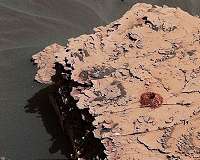
NASA's Curiosity rover successfully drilled a 2-inch-deep hole in a target called "Duluth" on May 20. It was the first rock sample captured by the drill since October 2016. This image was taken by Curiosity's Mast Camera (Mastcam) on Sol 2057. It has been white balanced and contrast-enhanced. Image courtesy NASA/JPL-Caltech/MSSS

Engineers working with NASA's Curiosity Mars rover have been hard at work testing a new way for the rover to drill rocks and extract powder from them. This past weekend, that effort produced the first drilled sample on Mars in more than a year.

Curiosity tested percussive drilling this past weekend, penetrating about 2 inches (50 millimeters) into a target called "Duluth."

NASA's Jet Propulsion Laboratory in Pasadena, California, has been testing this drilling technique since a mechanical problem took Curiosity's drill offline in December of 2016. This technique, called Feed Extended Drilling, keeps the drill's bit extended out past two stabilizer posts that were originally used to steady the drill against Martian rocks. It lets Curiosity drill using the force of its robotic arm, a little more like the way a human would drill into a wall at home.

"The team used tremendous ingenuity to devise a new drilling technique and implement it on another planet," said Curiosity Deputy Project Manager Steve Lee of JPL. "Those are two vital inches of innovation from 60 million miles away. We're thrilled that the result was so successful."

Drilling is a vitally important part of Curiosity's capabilities to study Mars. Inside the rover are two laboratories that are able to conduct chemical and mineralogical analyses of rock and soil samples. The samples are acquired from Gale Crater, which the rover has been exploring since 2012.

Curiosity's science team has been eager to get the drill working before the rover leaves its current location near Vera Rubin Ridge. Fortunately, it was near enough to drill targets like Duluth to drive back down the ridge. Sunday's drill sample represents a quick taste of the region before Curiosity moves on.

Demonstrating that Curiosity's percussive drilling technique works is a milestone in itself. But that doesn't mean the work is over for engineers at JPL.

"We've been developing this new drilling technique for over a year, but our job isn't done once a sample has been collected on Mars," JPL's Tom Green, a systems engineer who helped develop and test Curiosity's new drilling method. "With each new test, we closely examine the data to look for improvements we can make and then head back to our testbed to iterate on the process."

There's also the next step to work on: delivering the rock sample from the drill bit to the two laboratories inside the rover. Having captured enough powder inside the drill, engineers will now use the rover's cameras to estimate how much trickles out while running the drill backwards. The drill's percussion mechanism is also used to tap out powder.

As soon as this Friday, the Curiosity team will test a new process for delivering samples into the rover's laboratories.


Related Links
Curiosity Mars Science Lab
Mars News and Information at MarsDaily.com
Lunar Dreams and more

MARSDAILY
NASA's Curiosity Rover Aims to Get Its Rhythm Back
Pasadena CA (JPL) May 18, 2018
NASA's Curiosity rover could soon be drilling rocks on Mars again. Engineers have been working for the past year to restore the rover's full drilling capabilities, which were hampered in 2016 due to a mechanical problem. Later this weekend, they'll be adding percussion to a new technique already in use on Mars. This new technique is called Feed Extended Drilling, or FED. It lets Curiosity drill more like the way a person would at home, using the force of its robotic arm to push its drill bit forwa ... read more

Comment using your Disqus, Facebook, Google or Twitter login.

Share this article via these popular social media networks
del.icio.usdel.icio.us DiggDigg RedditReddit GoogleGoogle

MARSDAILY
China satellite heralds first mission to dark side of Moon

Dutch Radio Antenna To Depart For The Moon On Chinese Mission

Chinese volunteers emerge from virtual moon base

Take me to the Moon

MARSDAILY
China's Queqiao satellite carries "large umbrella" into deep space

Russia May Help China Create International Cosmonauts Rehabilitation Center

Sunrise for China's commercial space industry?

Chinese rewrite record, live 370 days in self-contained moon lab

MARSDAILY
Discovery of the first body in the Solar System with an extrasolar origin

Interstellar asteroid in orbit around Sun

Asteroid Institute Announces Program with York Space Systems to Explore Low-Cost Space-Based Asteroid Tracking System

Football field-sized asteroid to shave by Earth

MARSDAILY
Study co-authored by UCLA scientists shows evidence of water vapor plumes on Jupiter moon

Jupiter: A New Perspective

Old Data Reveal New Evidence of Europa Plumes

New views of Jupiter" showcases swirling clouds on giant planet

MARSDAILY
Cosmic Ravioli And Spaetzle

MARSDAILY
Scientists uncover likely cheating on ozone treaty

UAE Space Agency conducts MeznSat preliminary design review

NOAA reports rising concentration of ozone-eating CFCs

The open air as an underappreciated habitat

MARSDAILY
US spacewalkers swap, check coolers 'Leaky' and 'Frosty'

NASA sends new research on Orbital ATK mission to Space Station

Science Launching to Space Station Looks Forward and Back

UAE Astronaut to Fly to ISS Instead of US Businessman - Source

MARSDAILY
Amateur astronomer's data helps scientists discover a new exoplanet

Extrasolar asteroid has been orbiting sun for over 4 billion years

Planet hunter snaps test image on Lunar flyby on route to final orbit

Orbital variations can trigger 'snowball states' on exoplanets